
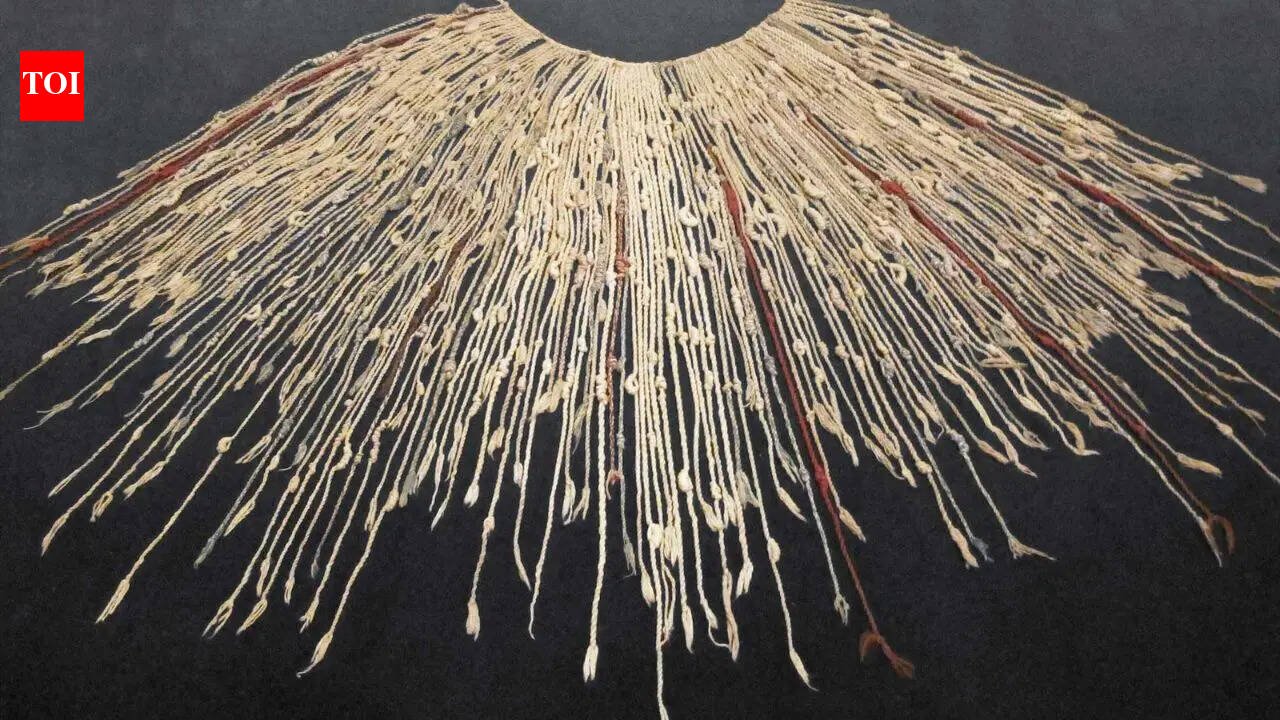
Before smartphones, spreadsheets, or even written alphabets as we know them, the Inca appear to have managed information in a way that still feels surprisingly advanced. Their system, known as quipu, used knotted cords and colour-coded strings to store records across a vast empire. It was long thought to be mainly numerical. Recently, the research was accepted in February 2026, though it suggests something broader. Some scientists reportedly see quipu not just as a counting tool, but as a structured way of organising and processing information. Almost like a primitive computing system. That idea has sparked debate, curiosity, and a fair bit of scepticism too. Still, the possibility alone is intriguing. A civilisation without a written script. Yet managing complex administrative data across regions.
What is the structure behind quipu knots and Inca records
For years, scholars such as Marcia Ascher and Robert Ascher argued that quipu knots likely represented a decimal-based numerical system. Each knot, each position, carries meaning in a structured way. Other researchers, including Sabine Hyland, have suggested that quipus may encode linguistic elements as well. Symbols that could represent sounds or concepts. Around 95 possible markers have been proposed in some studies. These features appear to carry meaning beyond simple counting. The structure feels layered, almost modular. Not unlike how modern systems organise data into categories and subcategories.Single knots alone don’t explain the full picture. The system seems to rely on relationships between elements. That complexity is where things start to look less like a ledger and more like an information framework.
How quipu resembles tree-like data structures used in computer science
A different perspective came from Richard Dosselmann, a computer scientist who looked at quipu through the lens of data structures. Along with colleagues Edward Doolittle and Vatika Tayal, he reportedly approached the system not as something to decode, but as something to model. Their idea was simple in concept. Quipu cords branch from a main cord. That hierarchy mirrors tree-like data systems used in computing today. The researchers translated these properties into programming logic using languages like C++ and Python. They even created a file format designed around quipu principles.
Quipu-based prototypes and how they work in simple terms
The team reportedly built working prototypes based on quipu logic. A spreadsheet model. Even an image representation tool. These weren’t historical replicas, but they were modern applications inspired by the structure. The hierarchy allows data to be added without restructuring everything. The organisation also scales in a linear way, which makes it suitable for layered datasets like census records or inventories.
Hidden layers of meaning and possible encryption
One of the more unusual aspects of quipu is how flexible its structure appears. According to the researchers, scrambling the arrangement of cords at different levels could function as a form of data protection. Not encryption added on top, but embedded within the structure itself. That’s quite different from modern systems, where encryption is typically applied separately. Here, the organisation of the data already contains the mechanism for obscuring it.The Inca likely weren’t designing cryptographic systems. Yet the properties of their method appear to allow it.
Why quipu is considered an early information system rather than a true computer
Calling quipu a “computer” might sound like a stretch. There’s no electricity, no processors, no binary code in the modern sense. Still, the comparison is not entirely out of place. What the Inca developed was a structured, scalable, and adaptable method of storing and managing information. One that supported hierarchy, grouping, and summarisation. Features that sit at the core of many computing systems today.Experts say it might be more accurate to view quipu as an early information technology rather than a literal computer. A system built for organisation rather than calculation alone.