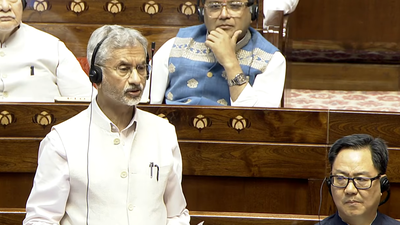
NEW DELHI: External affairs minister S Jaishankar on Monday said that India believes that dialogue and diplomacy should be pursued to de-escalate the tensions in the Middle East.While outlining India’s stand in Rajya Sabha, Jaishankar said that Prime Minister Narendra Modi is closely monitoring the developments and relevant ministries are coordinating to ensure effective responses.
“Our government had issued a statement on 20th February expressing deep concerns and urging all sides to exercise restraint. We continue to believe that dialogue and diplomacy should be pursued to de-escalate the tensions,” Jaishankar said amid sloganeering by Opposition MPs.“The Prime Minister continues to closely monitor the emerging developments, and relevant ministries are coordinating to ensure effective responses. Given the gravity of the situation, the Cabinet Committee of Security (CCS) met on March 1, under the chairmanship of the Prime Minister. It was briefed on the airstrikes in Iran and the subsequent attacks in several Gulf countries. The CCS was concerned over the safety and security of the Indian community in the region,” he added.The EAM said that the ongoing conflict in the Middle East is of “particular concern” for India as over one crore Indians live and work in the Gulf nations and region. He also added that the region is key to India’s energy security and includes many important suppliers of oil and gas. “This ongoing conflict is of particular concern to India. We are a neighbouring region, and have obvious stakes that West Asia remains stable. There are one crore Indians who live and work in the Gulf nations. In Iran, too, there are a few thousand Indians for study or employment. The region is key to our energy security and includes many important suppliers of oil and gas. Serious supply chain disruptions and a climate of instability are serious issues,” Jaishankar said.“The conflict has continued to intensify, and the security situation in the region has deteriorated significantly. The conflict has spread to other countries with mounting destruction. Normal life and actitivites in are visibly affected. The Indian Embassy has facilitated the relocation of several Indian students in Tehran to places outside. Indian nationals in Iran on business were facilitated to cross over to Armenia to return to India. Our Embassy in Tehran remains fully operational and on high alert. We are committed to supporting the Indian community at this time,” he added.Jaishankar also said that Iran’s foreign minister expressed his country’s thanks to India for this human gesture of permitting the Iranian warship Lavan to dock at Kochi port.“Contacts with Iran at the leadership level are obviously difficult at this time….Iran’s foreign minister has expressed his country’s thanks to India for this human gesture of permitting the Iranian warship Lavan to dock at Kochi port.”Jaishankar also informed the House that two Indian mariners (merchant shipping) were killed while and one remains missing due to the ongoing conflict.“We have lost two Indian mariners (merchant shipping), and one remains missing,” he said.At least 1,230 people have been killed in Iran, 397 in Lebanon, 11 in Israel and seven Americans since the war between the United States, Israel and Iran began. In Lebanon, the fighting has displaced more than half a million people, though authorities say the real number is likely higher. The official figure of 517,000 reflects only those who registered on the government’s online portal.Beyond the battlefield, the conflict has triggered a widening humanitarian and economic shock. Global energy markets have been rattled, pushing oil prices above $100 a barrel and tightening natural gas supplies after QatarEnergy halted production. Israel’s renewed offensive followed rocket attacks launched toward northern Israel by Hezbollah during the opening days of the Iran war.The war in the Middle East began on February 28 with a massive joint strike by the United States and Israel targeting military bases, missile launch sites and strategic facilities across Iran, including in Tehran, Isfahan and Kermanshah.The most dramatic development was the killing of Iran Supreme Leader Ayatollah Ali Khamenei in what analysts described as a “decapitation strike” aimed at crippling Iran’s leadership. Several senior military commanders were also reported killed.