
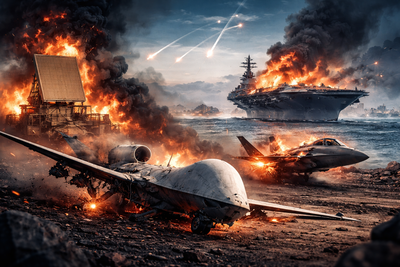
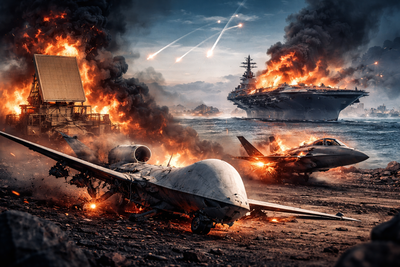
In the ongoing Iran war, the United States and Israel have together lost more than two dozen aircraft along with several high-value military systems, including advanced radar networks and key assets, as Iran’s strikes begin to mount both operational and reputational costs for Washington.In just 21 days of conflict, Iran is assessed to have shot down or damaged at least 17 aircraft and targeted multiple high-profile assets, including THAAD radar systems, an F-35 stealth fighter jet, and even the USS Gerald R Ford aircraft carrier, though not all incidents were caused directly by enemy fire.While the US and Israel have inflicted heavy damage on Iran’s military capabilities, the scale and nature of their own losses have drawn attention, particularly as relatively low-cost Iranian systems appear to have successfully targeted some of the most advanced and expensive military equipment in the US arsenal.Before the war began, few analysts expected Iran, constrained by years of sanctions and operating an ageing air force, to inflict such damage. However, Tehran has demonstrated that even billion-dollar platforms can be vulnerable to unconventional and cost-effective tactics.
Mounting aircraft losses
Since the start of the conflict, the US suffered damage to 16 aircraft, including 12 MQ-9 Reaper drones, which have been extensively used in West Asia operations.Each MQ-9 Reaper drone costs up to US$56.5 million, indicating losses exceeding US$500 million in drones alone. These drones have been central to US surveillance and strike operations in the region.In addition, three F-15 Strike Eagle fighter jets were lost in Kuwait on March 2, reportedly due to a friendly fire incident that remains under investigation.The US Air Force also lost a KC-135 refuelling tanker over Iraq on March 12, killing all six crew members on board. Another KC-135 aircraft was damaged in the same incident.In a development that could have far-reaching consequences, Iran reportedly struck a US F-35 stealth fighter jet over its airspace on March 19. The US Central Command confirmed that the aircraft made an emergency landing and that the pilot was stable, though it did not specify the cause.If confirmed, this would mark the first instance of a country successfully hitting the F-35 Lightning II Joint Strike Fighter, one of the most advanced and expensive military programmes in history, with life-cycle costs exceeding US$2 trillion.The F-35, manufactured by Lockheed Martin, is the world’s most widely produced stealth fighter, with nearly 1,300 units delivered so far.A successful strike on the F-35 could have implications beyond the Middle East, particularly in the Indo-Pacific region, where countries such as Japan, South Korea, and Singapore operate the aircraft. It could also offer valuable tracking data to adversaries such as China and Russia.Meanwhile, Israel has reportedly lost over a dozen drones in Iranian airspace, bringing the combined aircraft losses of the US and Israel to 28.
High-value radar systems targeted
Beyond aircraft, Iran’s strikes have focused on degrading the US missile defence network in the region by targeting high-value radar systems.According to claims by Iran’s Islamic Revolutionary Guard Corps, up to four AN/TPY-2 radars associated with THAAD systems have been hit.One such radar was reportedly destroyed in Jordan early in the conflict. Two others are believed to have been targeted in the UAE, including one at Al-Ruwais Industrial City, while another may have been struck at Prince Sultan Air Base in Saudi Arabia.Each AN/TPY-2 radar is estimated to cost between US$300 million and US$500 million.Globally, there are only 10 THAAD systems, of which the US operates seven, while the UAE and Saudi Arabia operate the remaining three. Reports suggest that up to four of these systems may now be inoperable due to the conflict.Separately, Iran has claimed to have struck an AN/FPS-132 Block 5 Upgraded Early Warning Radar at Al Udeid Air Base in Qatar.This radar, valued at around US$1.1 billion, is a long-range ballistic missile detection system capable of tracking threats up to 5,000 kilometres and supporting integrated defence systems such as THAAD, Patriot, and Aegis.Qatar has confirmed that the radar was hit and damaged. There are only six such systems in operation globally.The targeting of these radars represents a significant challenge to the US’s layered missile defence architecture in the region.The IRGC said that the destruction of these systems has effectively expanded Iran’s offensive capability, stating that “the missile hand of the Islamic Republic of Iran has been opened for successful target hits.”
USS Gerald R Ford incident raises concerns
The USS Gerald R Ford, the US Navy’s most advanced aircraft carrier, has also been rendered temporarily inoperable, though not due to direct enemy action.A fire broke out aboard the carrier, requiring over 30 hours of firefighting efforts by crew members. The vessel is now set to undergo repairs at the Naval Support Activity Souda Bay in Crete.The incident has prompted an investigation into its cause, with US media reports suggesting the possibility of deliberate sabotage.According to International Business Times (UK), “the US Navy is investigating whether sailors aboard the USS Gerald R. Ford deliberately started the fire that tore through the aircraft carrier’s main laundry spaces on 12 March.”“The investigation explicitly includes the possibility of deliberate sabotage by crew members, with one theory suggesting the fire was intentionally set to interrupt the carrier’s lengthy and repeatedly extended mission.”The USS Gerald R. Ford has been deployed for nearly ten months, far exceeding standard deployment durations. Its mission had already been extended multiple times, contributing to fatigue among crew members.Originally deployed in June last year, the carrier was later reassigned to multiple theatres, including the Mediterranean and the Caribbean. Its prolonged deployment has delayed scheduled maintenance and upgrades at the Newport News Naval Shipyard in Virginia.Even if the fire was accidental, the strain on the vessel and its crew due to repeated extensions may have played a role.
Rising financial cost of war
Apart from equipment losses, the war is imposing a heavy financial burden on the United States.According to the Center for Strategic and International Studies, the cost of munitions alone exceeded US$12 billion in the first six days of the conflict, while the Pentagon estimated it at US$11.3 billion for the same period.This translates to a daily expenditure of nearly US$2 billion on munitions.For instance, each Tomahawk missile costs around US$3.5 million, and the US has already used over 300 of them, amounting to more than US$1.2 billion.To sustain the war effort, the Pentagon has reportedly requested over US$200 billion in additional funding from Congress to replenish depleted stockpiles and increase weapons production.The Washington Post reported, citing senior US officials, that the funds would be used to boost production of critical weapons systems after extensive use in strikes against Iranian targets.The scale of expenditure and depletion of munitions stocks could have broader strategic implications, potentially affecting US preparedness in other theatres, including a possible conflict scenario involving China or Russia.
Claims and counterclaims on Israeli aircraft
Amid the escalating conflict, Iran has also claimed to have struck an Israeli F-16 fighter jet over central Iran.“An F-16 hostile enemy fighter jet belonging to the Zionist regime was struck at 3:45 am in central Iran.”However, Israel has denied that any damage occurred, stating that one of its aircraft was targeted by a surface-to-air missile during operations but remained unharmed.The Israeli military said that “no damage was caused to the aircraft.”There is currently no independent verification of whether the aircraft was hit or sustained operational damage, and no evidence of a crash or wreckage has emerged.The competing claims highlight the fog of war and the difficulty in independently verifying battlefield developments.
Strategic implications
The Iran war has not only resulted in material losses but has also exposed potential vulnerabilities in some of the US military’s most advanced systems.From MQ-9 Reaper drones and F-35 fighters to THAAD missile defence systems and high-value radar networks, several frontline assets have come under pressure.At the same time, Iran’s ability to target these systems using comparatively inexpensive methods could reshape perceptions about modern warfare, particularly regarding cost asymmetry.As the conflict continues, both the operational and strategic consequences of these losses are likely to be closely studied by military planners around the world.