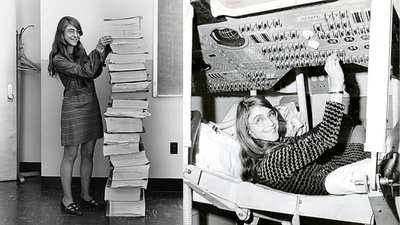
Margaret Hamilton, standing tall with her back to the camera and proudly facing the mountain of Apollo code she had developed, is not only a historic picture, but it is also a representation of the human spirit, precision, and ingenuity. Indeed, the code developed by Margaret Hamilton played a very important role in 1969 in the safe landing of the astronauts on the moon, which is one of the biggest milestones in the history of human achievement. Today, as NASA is gearing up to send humans farther than ever before in nearly 50 years with its historic Artemis II mission, Margaret Hamilton’s work is alive. The move from code to software is a testament not only to technological progress but also to a belief in software as a tool in space exploration.
How Margaret Hamilton’s Apollo code made the Moon landing possible
Margaret Hamilton supervised a division at MIT called the Software Engineering Division, which designed flight software used in NASA’s Apollo missions. As NASA describes, “Margaret’s work in flight software was revolutionary not only because it enabled humans to land on the moon, but because it launched the term ‘software engineering’ itself.”The well-known photograph of Margaret Hamilton was taken in 1969 and depicts her standing beside printouts of the code written by her team for both the Command Module and the Lunar Module. This code wasn’t simply written; rather, it was written in a way that enabled it to process errors that might occur during a mission. During the descent of Apollo 11, when the computer went into overload, the code enabled the mission to continue by prioritising tasks.Speaking about her work on the mission, Margaret Hamilton said, “There was no second chance. We knew that.”
Apollo to Artemis II: A new era of lunar exploration
Fast forward to the year 2026, and NASA is set to send its Artemis II mission to the Moon with four astronauts on board. The mission is expected to take ten days. It is the first mission to fly by the Moon with humans on board since the Apollo 17 mission.One major difference between the Artemis II mission and the Apollo missions is the technology used. Unlike the Apollo missions, theArtemis II mission utilises the much more advanced computing technology. Nevertheless, the main aim of the mission is remarkably similar to the Apollo missions. It is meant to test the technology to take humans further into space.Additionally, the mission is historic because it is the first mission to send the first woman and the first person of colour farther than low Earth orbit. Space travel is not only technologically evolving but also socially.
Software engineering legacy in Artemis missions
While Artemis II uses far more advanced software than Apollo’s 72 kilobytes of memory, the basic premise is still the same. Hamilton’s approach to developing systems that can identify, prioritise, and overcome errors still influences NASA’s approach to engineering.Hamilton’s work demonstrated that software was not merely an auxiliary system, but a mission-critical system. She once said to TIME magazine after Apollo 11, “It worked.” These three simple words illustrate the heart of trust in software, a trust that still exists in Artemis II today.While today’s spacecraft possess a range of advanced technologies such as diagnostic systems, real-time communication systems, and navigation systems, they still follow the same basic premise: software has to be reliable, even in extreme conditions.
From handwritten code to the future of space exploration
The evolution from Margaret Hamilton’s handwritten listings to the sophisticated technology used in Artemis II is one such story. It is the story of human ingenuity evolving over the course of several decades. It is the story of innovation building on innovation.As Artemis II is about to make its way around the Moon, it is not only conducting a test of the latest technology but also a celebration of the pioneers who made it all possible. Margaret Hamilton’s work is a testament to the fact that behind every successful mission, it is not the technology but the lines of code written with foresight and courage.Artemis II is not only making its way back to the Moon but is also a continuation of a woman standing next to her code listings and showing the world that even in the vastness of space, it is the ingenuity of humans that remains the driving force.