
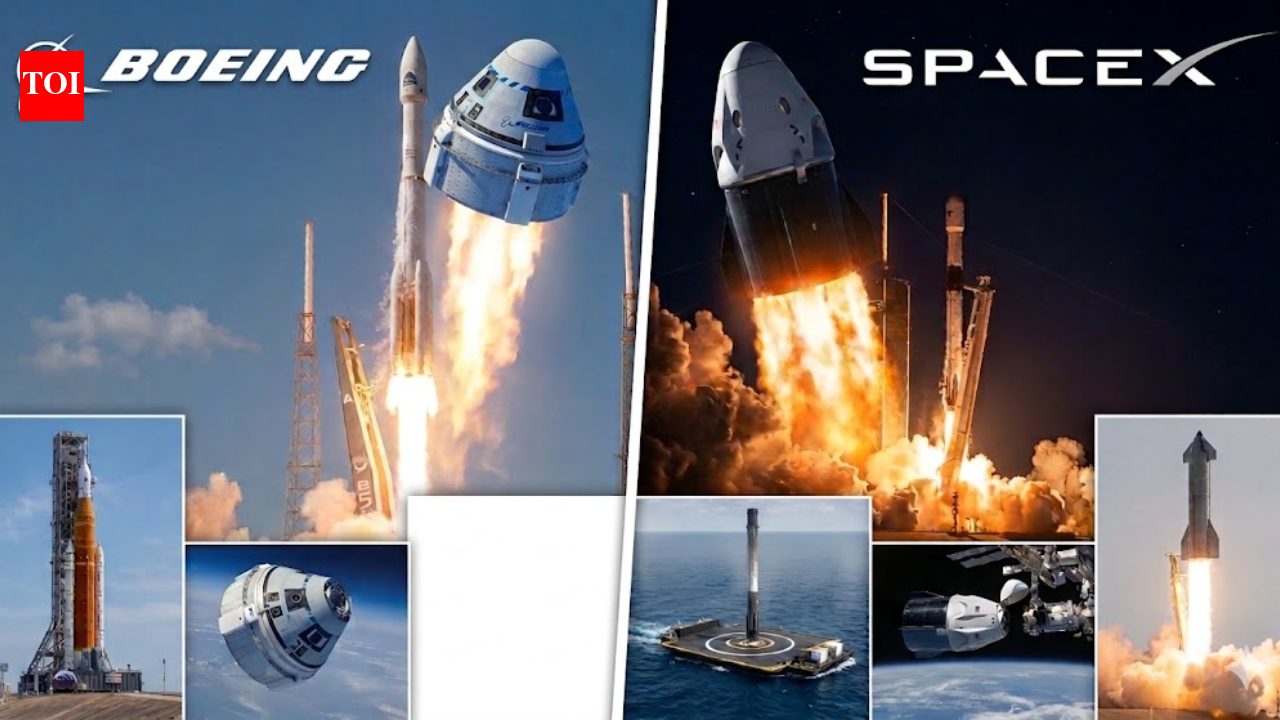
Picture NASA’s goal of sending astronauts back to the Moon is picking up speed, but there’s a twist that is affecting major players in spaceflight. As of February 2026, the agency announced plans to increase Artemis missions, adding an extra flight in 2027 and aiming for annual Moon landings after that. According to a Bloomberg report, SpaceX’s powerful Starship is taking on a major role as the Human Landing System (HLS), potentially leading lunar transportation and landings, while Boeing’s Space Launch System (SLS), once the main vehicle for deep-space missions, faces a reduced future. This change, due to delays and cost problems, keeps Orion important but reevaluates the heavy lifting. “NASA is committed to using the SLS architecture through at least Artemis V, which is necessary to support both HLS providers, and their associated acceleration plans to return American astronauts to the Moon,” NASA’S Administrator Isaacman said in a statement provided by an agency spokesperson.
Starship takes lead in lunar landings
Starship’s role in NASA’s lunar plan is significant. It started as the Human Landing System (HLS) for transporting astronauts from orbit to the surface. Now, it is being considered for additional tasks, such as sending the Orion spacecraft to the Moon, a role that was originally assigned to the SLS Block 1B upgrades. NASA’s announcement on February 27 set standardized vehicle configurations to improve reliability. It also included a 2027 Low-Earth orbit (LEO) test rendezvous with Starship or Blue Origin’s lander before Artemis IV’s planned landing in 2028. This adjustment accelerates the schedule in response to the competition from China. Isaacman emphasized the need for speed by saying, “With credible competition, we need to move faster.” Amit Kshatriya, associate administrator, stressed the importance of the goal of flying the landing missions in the same Earth ascent configuration, with priority on Block 1 configurations rather than riskier changes.
Boeing SLS involvement reduced
Boeing, the manufacturer of the SLS core stages at the Michoud Assembly Facility, now finds the ambitions of the SLS diminished. No longer lofting the Orion spacecraft into lunar orbit, the SLS now only performs Earth orbit launches. These changes have reduced the upgrades and production ramps of future SLS Block upgrades. However, Steve Parker of Boeing assured the public that “Boeing is a proud partner… our workforce and supply chain are prepared to meet the increased production needs,” touting the SLS as “the world’s most powerful rocket stage.Orion may survive for the purposes of human return vehicles, but propulsion limitations have highlighted the reusability of Starship over the $4 billion SLS cost per mission.
Artemis’ future with SpaceX dominance
Artemis III transitions into LEO systems checks such as docking, life support, and xEVA suits, facilitating a smoother set of lunar hops. Lori Glaze exclaimed, “Our team is up to the challenge… enabling a more frequent cadence.” As April’s launch for Artemis II nears, post-helium fixes, this new era of Starship is poised for quicker returns to the Moon, marrying old tech with innovative vision for a lasting presence.