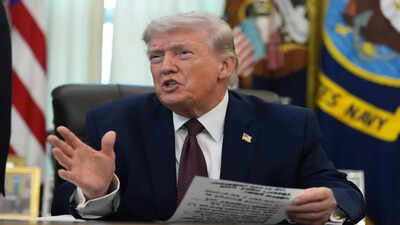
US President Donald Trump has once again threatened to exit the North Atlantic Treaty Organisation (Nato), a threat he has been making since 2016. The latest threat to pull out of the alliance was sparked after Nato allies refused to take part in an effort to open the critical Straits of Hormuz for shipping. The closure of the strategic maritime choke point, through which roughly 20% of the world’s oil and gas pass, has left global energy prices spiraling. Donald Trump has long said that other members of the alliance are not pulling their weight financially.In a recent interview with The Telegraph, Trump spoke about leaving the alliance, adding, “I was never swayed by Nato. I always knew they were a paper tiger, and Putin knows that too, by the way.”The Nato alliance, formalised in April 1949, began as a mutual defence agreement for its member states. The treaty was initiated soon after the Second World War by nations of Western Europe as well as the US and Canada. Article 5 of the Nato treaty is the collective defence clause, which gives the alliance its teeth: an attack on one member is considered an attack on all.Nato currently has 32 members, stretching from the US and Canada in the west to Turkey in the East. The alliance faced off against the Soviet Union’s Warsaw Pact from 1955 to 1991, till the end of the Cold War. After the fall of the Berlin Wall, Nato became the uncontested most powerful military alliance.In the most powerful military alliance, the United States stands out as the biggest player. The United States adds the most value to the alliance in terms of both military capability and financial capability.In 2025, the combined defence budget of Nato members was equivalent to $1,588 billion. The United States alone added $980 billion to this total or about 61% of the total amount. The next highest defence budget was Germany’s, $93 billion, less than 10% of America’s defence budget. Followed by the UK, which stands at $90 billion. In terms of equipment, the United States far surpasses other members of the alliance. The United States alone has well over 2,500 fighter aircraft across its air force, navy and marine corps. This figure does not include the bombers, AEW&CS, and refuelers. While European nations have approximately 1,300 fighter aircraft. This is less than half the number of fighters that the U.S. brings to the table.In the very critical realm of aerial surveillance, the Americans take a massive lead: the United States Air Force has over 30 AEW&CS aircraft, the US Navy has another 50 or so, and the remainder of Nato has 28 such aircraft. Fourteen of these are in a dedicated NATO AEW&CS unit, which is partially staffed with American personnel and this unit operates a US-made platform. The United States also takes a wide lead for other airborne force multipliers such as mid-air refuelers. The US has a fleet of over 440 such planes while the combined European fleet stands at 156 according to Washington DC based publication National Interest.When it comes to tanks, the numbers shift in favour of Nato nations. The Americans have 2,600 active tanks in its fleet, while some 2,000 tanks are kept in storage. Turkey takes the cake for having the second-largest tank fleet with approximately 2,200 tanks, the vast majority of these tanks, though, are much older Cold War holdovers. Greece, is the next largest operator with over 1,300 tanks. The third-largest tank fleet belongs to Poland with nearly 800 tanks, which is more than the combined tank fleet of the UK and France.In the naval realm too, the US outclasses its European partners by a margin. The Americans have a grand total of 11 super carriers and 9 smaller carriers or Amphibious Assault Ships, which carry F-35Bs of the United States Marine Corps. While on the other hand the Europeans have four aircraft carriers and seven helicopter carriers. The story is quite different for submarines, as other NATO members, with 78 submarines outshine their American counterparts who are equipped with 66, according to the Global Firepower portal.Trump has therefore been urging his European counterparts and Canada to take more responsibility of their defences. The US President has repeatedly admonished other Nato members to increase their defence spending to 2% of GDP. At the Hague Summit in 2025, Nato members pledged to increase their individual defence spending to 5% of GDP, as first proposed by Trump. According to the Swedish think-tank SIPRI, the Nato plan to increase defence spending to 5% was taken to placate US President Trump. Other reasons to gradually increase the defence spending to 5% of GDP is to ‘demonstrate resolve, unity and a commitment to shoulder the burden of responsibility of security and defence.’The increase in defence spending, and thereby preparedness, is also to act as a deterrence against Russia. As per the same Sipri report in the increased defence spending 3.5% will be kept for core defence spending, while the remaining 1.5% will be reserved for dual-use purposes such as protection for defence and security-related spending, to defend infrastructure, networks and to strengthen the defence industrial base as per a SIPRI report. It is reported that one of the reasons for the increase in the defence budget over the decade is also an insurance for the bloc, in case the Americans do leave the alliance. Nato members have increased their defence spending from a combined GDP spending of 1.43% in 2014 to 2.02% of GDP in 2024 as per a Nato report.The ongoing conflict in West Asia has brought tensions between Washington DC and Brussels (where Nato Headquarters are located) as well as other capitals in Europe. Trump had asked European partners to assist in the opening of the Straits of Hormuz. The US president asked his allies to “build up some delayed courage”. He also asked them to “start learning how to fight for yourself”. Warning other Nato members that “the USA won’t be there to help you anymore, just like you weren’t there for us”.In the ongoing conflict, Greece, Italy and Poland have refused to take part in any operation to open the Strait of Hormuz. While Germany has stated that they will not take part in any operation until a ceasefire has been established. UK, America’s closest ally in Europe, and France have stated that they will not participate in any offensive action against Iran.The conflict with Iran has upended the global energy paradigm and Europe has been disproportionately affected by this conflict. The Europeans, before the invasion of Ukraine were procuring a substantial amount of their energy from Russia. The continent had to scurry to West Asia to secure its energy needs, especially for gas that feeds its power plants.Trump, according to Reuters, says that he is ‘absolutely considering withdrawing from the 77-year-old alliance that has been the cornerstone of the West’s defensive framework.’ The National Defense Authorization Act for Fiscal Year 2024, passed in 2023, requires a super majority or 66% of the votes in the US Congress to withdraw from the alliance. This could perhaps be a roadblock for Donald Trump and would question the legality of any such step taken by the incumbent of the White House.Nato, as a security bloc, depends on the United States’ military machinery to act as a deterrent force. If the US leaves the alliance it would adversely affect both the United States as well as other members of the alliance. The American muscle as well as European soft power give both sides of the Atlantic a level of dependency on the other side.