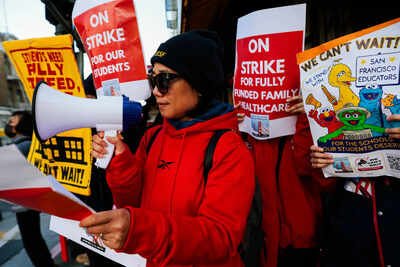
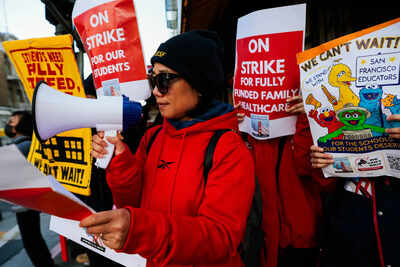
Every major education battle is framed as a fight over fairness. In California, it is also a fight over arithmetic.Thousands of K-12 teachers across the state have walked out, voted to strike or come close to it in recent months. The coordinated effort is led by the California Teachers Association, which represents about 310,000 educators. Ten local unions aligned their contracts to expire on June 30, 2025, with the aim of triggering simultaneous negotiations.As David Goldberg, president of the California Teachers Association, told the Associated Press, the clustering of strikes is deliberate and reflects long standing unmet needs.San Francisco teachers struck for four days. West Contra Costa teachers struck in December. In San Diego, Woodland, Apple Valley, Duarte and Madera, strikes were averted at the last minute through settlements. In Los Angeles, Oakland, Dublin, West Sacramento, Twin Rivers and Natomas, teachers have voted to strike. Other districts are holding rallies and preparing for possible votes.The strategy is clear. What remains uncertain is who ultimately carries the cost.
Salary demands meet shrinking revenue
Teachers argue that wages have not kept pace with the cost of living, especially in high cost cities. In San Francisco Unified School District, starting teacher pay is about $80,000, according to AP. Starting police officers earn about $120,000.For years, educators have said this imbalance affects recruitment and retention. But districts operate within state funding formulas. In California, school funding is largely tied to attendance. Declining enrolment in many urban districts has reduced revenue. Classrooms sit partially empty. The funding tied to daily attendance declines with them.Closing schools is one option. It is also politically unpopular. Few school boards have shown willingness to pursue it.Another pressure point is the end of pandemic relief funds. California schools received more than $23.4 billion in temporary state and federal aid intended to address learning loss. Authorities advised districts to use the money for short term programmes such as tutoring and summer learning. Some districts, including Los Angeles Unified School District, San Diego Unified School District and San Francisco Unified School District, used portions of the funds for permanent staff hires or salary increases.Now that the one time money has expired, districts must absorb those recurring costs.Marguerite Roza, director of the Edunomics Lab at Georgetown University, told AP that many districts are financially constrained even after recent increases in state funding. If districts meet union demands, she warned, reductions may follow elsewhere.
What gets cut when salaries rise
School budgets are finite. If compensation grows faster than revenue, programmes may shrink.According to AP, likely areas of reduction include sports, electives, advanced placement courses and enrichment offerings. Staff layoffs are also possible. Tutors, classroom aides and early career teachers are often the most vulnerable.The burden of such cuts does not fall evenly. Low income students are more likely to rely on after school programmes and supplemental services. They are also more likely to experience academic disruption during strikes because families have fewer childcare alternatives.Roza told AP that school boards must be transparent about finances and prepared to make difficult structural decisions, including closing under used campuses.
Critics question union leverage
The strike wave has also reignited debate over the political role of teachers unions.Lance Christensen, vice president of education policy at the California Policy Center, told AP that while teachers deserve higher pay, unions do not always act in students’ interests. He criticised strikes as harmful to families and argued that the California Teachers Association holds significant influence in Sacramento.Christensen also pointed out that many charter and private schools are not unionised and that several states restrict collective bargaining or prohibit teacher strikes altogether.Union leaders counter that collective action is necessary to secure resources for public schools. Goldberg told AP that educators across districts are learning from one another and coordinating strategies to strengthen negotiations.
San Francisco as a case study
In San Francisco, the recent settlement totals $183 million in raises and improved benefits, according to AP. The district plans to finance the agreement partly by drawing down reserve funds.Parents have expressed relief that classrooms have reopened. Meredith Dodson of the San Francisco Parents Coalition told AP that while many families support better compensation for teachers, the strike disrupted learning and created strain for households.The financial questions remain. Reserve funds are not permanent revenue. If structural deficits persist, districts may face layoffs, larger class sizes or, in extreme cases, state oversight.
A longer reckoning
The coordinated expiration of contracts marks a shift in tactics. By aligning timelines, unions have amplified their leverage and drawn attention to compensation gaps.At the same time, demographic decline and the end of federal relief have tightened district budgets. State funding increases have not erased structural imbalances.For students, the immediate impact is cancelled classes and uncertainty. The longer term impact may be more gradual. Programme reductions, fewer support staff and larger class sizes rarely arrive all at once. They accumulate.The central tension is not whether teachers should earn more. It is whether California’s current funding model can absorb those increases without reducing services elsewhere.As negotiations continue across districts, the answer will shape not only teacher contracts but the daily experience of millions of students.