
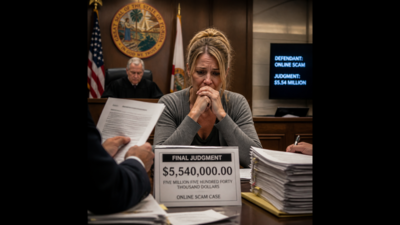
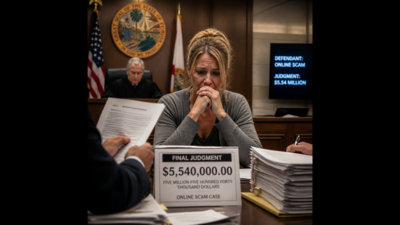
A Florida appeals court has upheld a $5.54 million judgment against a woman who used a power of attorney to move nearly $1.85 million from her mother’s bank account to people directed by an online scammer posing as French billionaire Francois-Henri Pinault, as per details on Justia U.S Law. The Third District Court of Appeal affirmed the Miami-Dade trial court’s summary judgment on November 25, 2026, in a case brought by Kimberly Langston’s brother, Michael Burrows, over the loss of their late mother Sherry Burrows’ money.The decision does not erase the emotional complexity of romance fraud, but it makes clear that being deceived by a scammer does not automatically excuse a financial agent who transfers an elderly parent’s funds without verification, documentation, or a clear benefit to the parent. The court found that Langston, acting under a durable power of attorney, first sent the money to her personal account and then transferred it to unknown recipients at the impersonator’s direction. Read more details about this case, as per the court details on Justia U.S Law, here:
How the money disappeared
According to the appellate opinion, Sherry Burrows signed a durable power of attorney in June 2013, naming her husband as agent and Kimberly Langston as successor agent. At some point, Langston became the agent with authority to manage her mother’s financial affairs. In March 2020, Langston emailed her brother to say that she had been defrauded by a man she met online who claimed to be Pinault, and that $1,845,740 of their mother’s money was gone.Langston testified that she became romantically involved with the impersonator after meeting him online. She did not dispute that she never met him in person or took steps to verify his identity while she was transferring her mother’s money to him and to other unknown individuals. The scammer convinced her that the money would be invested, according to the court’s account of the record.Before sending the funds to the unknown people, Langston transferred the money into her own personal bank account. When asked why, she had no explanation or reason for that intermediate transfer. The court treated that step as especially important because a power of attorney does not give an agent authority to transfer the principal’s property to the agent personally.
The brother’s lawsuit
Burrows sued Langston for exploitation of an elderly person, civil theft, breach of a promissory note, and unjust enrichment. He later moved for summary judgment on the exploitation and civil theft claims, relying on Langston’s admissions, deposition testimony, document responses, Wells Fargo bank records, a 2017 loan agreement, and an email he had sent to her.Langston argued that Burrows had not shown admissible evidence that their mother met Florida’s legal definition of an “elderly person,” and that he had not proved she acted with the required intent. Her opposition included only her written responses to interrogatories. The trial court rejected those arguments, granted summary judgment for Burrows, and entered a final judgment of $5,537,250 against her.Under Florida law, a person who proves by clear and convincing evidence that they were injured by theft or exploitation of an elderly person can recover three times their actual damages, along with attorney fees and costs. The statute also sets a minimum damages amount of $200.Why the court agreedThe appeals court first examined whether Sherry Burrows qualified as an elderly person under Florida’s exploitation statute. It found no dispute that she was over 60. The record also showed that she had been diagnosed with Alzheimer’s disease and had serious memory problems, including forgetting to take medication. Langston’s own messages described her mother’s illness and said that some days were good while others were bad.The court concluded that those facts supported a finding that Sherry’s ability to provide adequately for her own care and protection was impaired. It distinguished the case from a criminal precedent involving a victim who lived independently and had occasional forgetfulness. Here, the mother lived with Langston even though she wanted to return to Colorado, and her memory problems were serious enough to affect medication management.The court then turned to exploitation. Under the relevant Florida provision, exploitation can occur when an agent under a power of attorney breaches a fiduciary duty and causes an unauthorized transfer of property, particularly where the elderly person does not receive reasonably equivalent value in return. The court said a breach can arise from negligent conduct, although certain violations, such as fraud or intentional mismanagement, require more than negligence.
What the record showed
The appellate court identified several undisputed facts supporting the trial court’s conclusion. Langston transferred the money to herself, then sent it to unknown people or entities. She failed to confirm the identity of the person she was communicating with, performed no due diligence on the supposed investments, and obtained no receipts, evidence, or proof that any investments existed.The court also noted that she continued making transfers without any return on earlier investments, despite having knowledge or suspicion that the activity was illegal. One alleged payment involved $420,000 for the supposed release of Pinault’s agent, who was said to have been stopped by U.S. Customs. The court described these circumstances as multiple grounds supporting a finding that Langston exploited her mother.Langston argued that she had verified the impersonator’s identity through one video call. But the court pointed to her own messages, in which she said she initially thought the person on Skype was Pinault but later believed the call used a silent clip from an older video. Even after developing those doubts, she continued sending large sums at the impersonator’s request.A warning for familiesThe case is a stark example of how romance scams can move from private heartbreak into family financial devastation. The scammer used a convincing public identity, an online relationship, and promises of investment to direct money out of an elderly woman’s account. The court’s ruling, however, focused on Langston’s conduct as a fiduciary, not on whether she personally intended to steal from her mother.For families managing an older relative’s finances, the practical lessons are straightforward. Verify any person requesting money through independent sources, never rely solely on video calls or online profiles, keep investment documentation, and avoid moving funds through a personal account. A power of attorney is a serious legal responsibility, and the person holding it must act in the principal’s best interest rather than following instructions from an unverified online contact.The appellate court affirmed the trial court’s judgment, leaving the $5,537,250 award in place subject to any timely motion for rehearing. The opinion underscores that Florida’s civil exploitation and theft laws can impose substantial financial consequences when a trusted agent sends an elderly person’s savings to strangers based on an online scam.