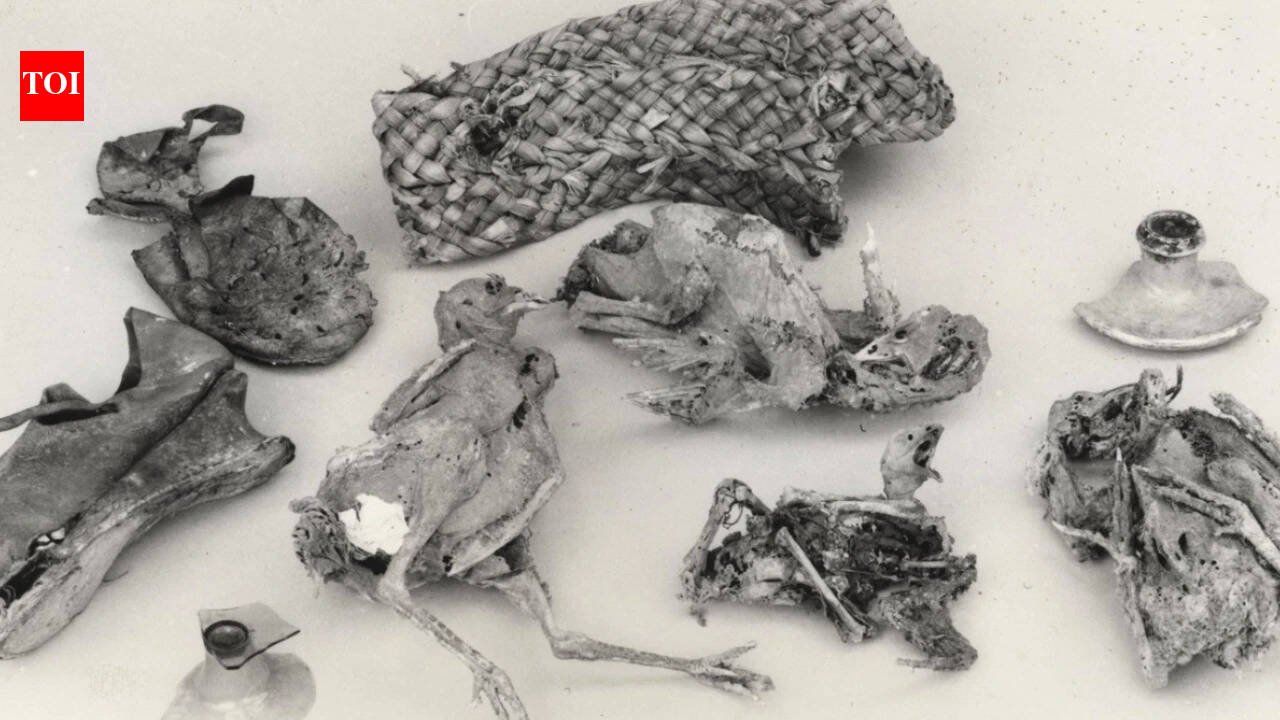
Everything concealed is strikingly revealing, suggesting, for one, that there was a reason it needed to be hidden in the first place.You may have heard that walls have ears, but did you know they can also be rather telling? For the walls of old houses can offer answers about the people who once lived within them, sometimes long after they are gone.In London, an otherwise ordinary reconstruction project brought to light a collection of objects concealed for centuries: belongings ranging from old shoes and broken household items to the dried bodies of four chickens.According to a report by Harriet Sweet-Escott and Mariarosa Spanu, published on the London Museum website, a 17th-century wicker basket containing several rather unusual objects was discovered during reconstruction work at Lauderdale House in Highgate, London, following a fire in 1963. The basket had been concealed behind a bricked-up wall, near the first-floor fireplace.Its contents included two shoes, one of which was dated to around 1650, a strip of plaited rush, a broken ceramic candlestick, a broken glass tazza and four desiccated chickens. As researchers examine the objects’ symbolism and why they might have been placed there, some suggest that they were deliberately concealed, with interpretations ranging from witchcraft to protection against supernatural dangers.
Why would anyone hide objects inside their walls?
The question of why someone would conceal objects, or go to the trouble of hiding an entire basket, cannot be answered without understanding how the beliefs of the time shaped people’s everyday lives in post-medieval England. The London Museum’s report suggests that fears surrounding witchcraft were widespread at the time, with evil spirits and supernatural forces being a source of concern. People often looked for ways to protect themselves from something they could neither see nor fully explain.The practice of hiding objects inside buildings was not particularly unusual in post-medieval Britain. Such objects were sometimes deliberately concealed as protective charms, intended to guard homes against harmful spirits. According to the London Museum, these objects were often placed near fireplaces, beneath floors, inside walls, around roofs and close to openings such as doors, windows and chimneys. These areas were considered particularly vulnerable to unwanted supernatural influences, making them important places to conceal protective objects.Folklore also suggested a fear surrounding chimneys, with witches supposedly able to enter or leave houses through them, sometimes arriving on broomsticks to cast harmful spells.Homeowners, families and builders sometimes concealed these objects during construction or renovation work. Some people also sought assistance from ‘cunning folk’, practitioners of folk magic who were sometimes consulted for protective rituals.
The curious case of the shoes
Among the objects recovered from Lauderdale House, there is a rather curious case of the two shoes. Unlike expensive jewellery or valuable possessions, old shoes might seem like an unlikely choice for something worth hiding inside a wall. Yet concealed shoes are among the most frequently discovered objects associated with these protective practices.Their significance may stem from the fact that shoes retained the shape of the wearer’s foot, creating an intimate association with the individual who wore them. Researcher Brian Hoggard, who wrote Magical House Protection: The Archaeology of Counter-Witchcraft (2019), has suggested that shoes could perhaps have been used as decoys to attract malevolent forces, trapping them among the sharp edges of other broken objects.However, there is another contrasting interpretation to consider. Ralph Merrifield, an archaeologist and former curator at the London Museum, suggested that the practice might have been influenced by the folklore surrounding John Schorn, a 14th-century English folk saint. According to legend, Schorn captured the devil inside his boot, a story that became popular after his death in 1313 and even inspired a pilgrimage tradition.Merrifield also suggested a rather different explanation: concealed shoes may have been kept by bereaved relatives as a way of preserving a connection with deceased loved ones. This possibility is particularly interesting because many concealed shoes discovered elsewhere belonged to children, who faced high mortality rates at the time.
Broken glass, household objects and the idea of ‘ritual killing’
The basket also contained a broken ceramic candlestick and a glass tazza, both of which raise questions about why someone would deliberately hide damaged household belongings rather than discard them.One possible explanation is that broken objects were believed to trap or harm supernatural entities. The idea of ‘ritual killing’ offers another possible interpretation: the deliberate breaking of an object to change its state and potentially release its protective significance. In this interpretation, the objects’ importance may not have rested entirely on their original use, but also on the fact that they had been deliberately damaged before concealment.Another curious item in the basket was a strip of plaited rush, which could have been associated with what is known as ‘knot magic’. This form of folk magic involves the use of knots to symbolise particular intentions, including protection. Author Della Farrant, who researched the Lauderdale House collection, explored this very possibility. However, there is another explanation too: the plaited material could simply have been part of a woven rush mat used for the chickens.
Four chickens hidden away for centuries
Two of the four birds discovered had apparently been strangled, while the other two may have been walled in alive. The latter possibility is particularly intriguing because researchers identified eggshell remains suggesting that at least one of the birds laid an egg after being sealed inside the wall.The chickens at Lauderdale House are presumed to have had a symbolic role. In several cultures, chickens have been associated with protection, with their claws being used as protection against the evil eye. The London Museum also points to central European folklore, where the crowing of roosters was thought to repel the devil. These beliefs offer possible explanations for why the birds might have been placed inside the basket, although their exact purpose remains uncertain.
What else could still be hidden inside old houses?
The discovery potentially points towards many more objects that may have remained hidden in historical buildings, preserved within their walls and forgotten spaces. These objects hold stories not just about the architecture, but also about the people who once owned and inhabited these spaces, preserving fragments of lives that might otherwise have been forgotten.Objects, in their own way, are always storytellers. Tucked away behind walls, beneath floors and inside forgotten spaces, they can remain untouched for generations, offering us much-needed insight into the everyday fears that Londoners grappled with, their customs and beliefs, and the stories that perhaps continue to foll