
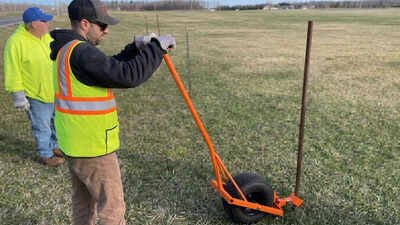
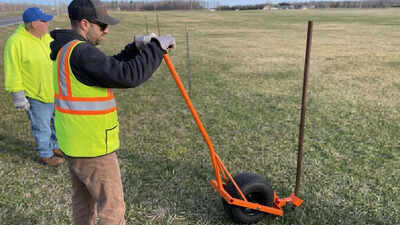
A discarded golf-cart wheel and a piece of scrap box tubing have earned a New York highway department national recognition. Riverhead Highway Superintendent Mike Zaleski built a simple snow-fence pole remover after seeing workers struggle to pull frozen poles from the ground by hand. The homemade tool cost nothing, reduced a job that once took about three weeks to roughly a week and a half, and helped prevent the back strain and injuries associated with the old method. The Riverhead News-Review reported that the invention won the Pioneer Award in the Federal Highway Administration’s 2026 Build a Better Mousetrap national competition. FHWA says the award recognised Riverhead’s use of entirely repurposed materials to reduce physical strain while improving productivity and safety. The invention is a reminder that meaningful public-works innovation can begin with scrap, observation and practical skill.A demanding winter routineEach year, the Riverhead Highway Department installs miles of snow fence to help control drifting snow.Snow fences are commonly placed near roads, open fields and other exposed areas where wind can carry snow onto the roadway. By slowing the wind, the fence encourages snow to settle before it reaches traffic lanes.The work is useful during winter, but it creates another demanding task when the season ends. Crews must remove the fencing and pull the supporting poles from the frozen ground.For years, workers handled that part manually. They gripped the poles, loosened them and pulled them out one by one. The process required repeated bending, lifting and force, often over many hours and across a large area.Riverhead Highway Superintendent Mike Zaleski saw the effect on his crew. Workers experienced back strain and other injuries, while the complete removal operation took about three weeks.“It’s strenuous, guys were getting hurt, it takes forever,” Zaleski told the Riverhead News-Review.An idea built from scrapZaleski decided that the department needed a tool that could pull poles from the ground without requiring workers to use their backs and arms for every lift.The resulting Snow Fence Pole Remover is made from an old golf-cart wheel and a piece of steel box tubing. The department built it using repurposed materials already available, so the cost was effectively zero.The tool consists of a single wheel attached to a steel frame. A section of box tubing slides over the snow-fence pole and grips it securely. The worker then uses the frame and wheel to create leverage and lift the pole from the ground.The mechanism is simple, but it changes the physics of the task. Rather than trying to pull a deeply embedded pole straight upward, the operator can use the wheel and frame to multiply force and guide the pole out.No motor, hydraulic pump or battery is required. The design relies on leverage, a stable frame and a wheel that allows the device to move easily from one pole to the next.Faster work and fewer injuriesThe most immediate benefit was the reduction in working time.Before the tool was introduced, the department needed approximately three weeks to remove the snow-fence poles. With the Snow Fence Pole Remover, the job takes about a week and a half, according to Zaleski.The improvement cuts the schedule by roughly half. That allows the crew to complete the seasonal task sooner and return to other highway responsibilities.The device also reduces the physical stress placed on workers. Zaleski said that no one was getting hurt anymore during the operation and that the department could complete the job twice as fast.This combination of safety and efficiency is important. A tool that merely speeds up a dangerous task would not solve the underlying problem. Riverhead’s invention changes the method itself, making the work less dependent on repeated heavy pulling.Workers still need to use the device carefully, but the central strain has been shifted from the human body to the steel frame and wheel.How the remover worksThe design is based on a straightforward sequence.A worker positions the device beside a snow-fence pole and slides the box tubing over it. The tubing holds the pole while the operator moves the frame and applies force through the wheel.The wheel acts as a pivot or rolling support. As pressure is applied, the frame creates leverage that loosens the pole and lifts it from the frozen ground.The tool can then be moved to the next pole. Because it is light enough to manoeuvre and does not depend on a fuel-powered engine, workers can use it repeatedly across the fence line.Its simplicity also makes maintenance easier. If a component becomes damaged, the department can likely repair or replace it using ordinary workshop materials.That matters in highway operations, where equipment may be used in cold, wet and muddy conditions. A complicated machine can be effective, but it may also require specialised parts or service. Riverhead’s tool is built around components that are easy to understand and adapt.Recognition in New YorkThe Snow Fence Pole Remover first gained attention through New York’s statewide Build a Better Mousetrap Competition.The competition is organised by the New York State Local Technical Assistance Program Center’s Cornell Local Roads Program. It invites transportation agencies to submit tools, equipment modifications and processes designed or built by local workers.The programme looks for ideas that improve safety, reduce costs, increase efficiency or improve the quality of transportation work. It does not require every entry to be a physical gadget. A new maintenance process, technology application or public-management strategy can also qualify.Riverhead’s invention won first place in the statewide competition. That victory automatically moved it forward to the national Federal Highway Administration competition.The state competition gave the department a platform to show how a small local improvement could produce measurable results. The invention did not require a large budget or a major research team. Its strength came from solving a specific problem faced by the crew.The federal Pioneer AwardThe Federal Highway Administration selected Riverhead’s Snow Fence Pole Remover for the 2026 Pioneer Award.FHWA says the Pioneer Award went to the Town of Riverhead Highway Department for developing a cost-effective innovation made entirely from repurposed materials. The agency highlighted the tool’s ability to reduce physical strain while increasing productivity and safety.The award formed part of the 2026 Build a Better Mousetrap national competition. FHWA evaluated more than 100 combined submissions from 2025 and 2026, making the recognition especially notable for a small town highway department.Other 2026 winners included a custom culvert steamer hook-lift body created by the Claremont Department of Public Works in New Hampshire, an AI-powered street right-of-way inventory developed by the City of Santa Maria in California and a roadway survey mobile rig designed by Johnson County, Iowa.Those projects used different technologies and addressed different transportation problems. Riverhead’s submission stood out for its low-cost construction and direct effect on worker safety.Why Build a Better Mousetrap mattersThe competition is designed to share practical ideas across the transportation sector.Local highway departments often face similar challenges, including snow removal, drainage maintenance, road inspections, equipment repairs and roadside safety. A solution developed in one community may be adapted by another.The New York programme encourages agencies to document their ideas, submit photographs and provide videos when possible. The national competition can then help bring those local solutions to a wider audience.That process is valuable because many useful improvements remain informal. A worker may create a bracket, attachment or method that makes a job easier, but the idea may never reach another department.Recognition gives the invention credibility and encourages other agencies to consider whether they can build their own versions.The Riverhead tool could be particularly easy to reproduce. A department with a welding area, scrap steel and a suitable wheel may be able to create a similar device after adapting the dimensions to its own poles and soil conditions.The value of worker-led innovationZaleski developed the device after observing the people who performed the work.He also enjoys welding outside his role as highway superintendent, giving him the skills to turn the idea into a working tool. His practical knowledge helped him create a frame that could withstand repeated use and provide the necessary leverage.This type of innovation often begins with close attention rather than a formal design process. Workers understand which movements cause pain, where equipment fails and which parts of a job consume the most time.Managers may know the overall schedule and budget, but employees often understand the physical details of a task better than anyone else. When they are encouraged to improve the process, small changes can produce significant results.Zaleski said the invention was created to make the department’s work safer and easier. He did not expect it to become a national award winner.That modest origin is part of the tool’s appeal. It was not designed for publicity. It was designed because workers needed a better way to do their job.A zero-dollar successThe Snow Fence Pole Remover also demonstrates how public agencies can innovate under financial constraints.Highway departments have to prioritise spending across many needs. Winter operations, pavement repairs, drainage work, traffic signs and vehicle maintenance can consume much of an annual budget.A new specialised machine may be useful but difficult to justify if the department can solve the problem with materials already in storage.Riverhead’s device converted an old golf-cart wheel and scrap box tubing into equipment that saves labour hours and reduces injury risk. The tool did not need a grant, purchase order or commercial contract.The financial saving extends beyond the construction cost. Completing the work sooner may reduce overtime, free staff for other assignments and lower the cost associated with workplace injuries.The idea also encourages departments to reconsider what they keep in their workshops. Materials that appear outdated or unsuitable may become valuable when combined with a new design.More than a clever gadgetAlthough the invention is physically small, its effects reach several parts of highway operations.The faster removal schedule improves productivity. The lower physical strain supports employee safety. The zero-dollar construction cost protects public funds. The simple design makes the tool easier to repair and reproduce.These benefits reinforce one another. A safer tool can reduce lost workdays, while a faster tool can reduce the number of hours workers spend exposed to cold weather and repetitive lifting.The device may also improve morale. Employees are more likely to feel valued when management responds to a difficult working condition with a practical solution.Zaleski said that management may steer the department, but the workforce consists of the people doing the difficult work. He compared the workers to the people rowing the boat.That message reflects the broader meaning of the award. Public infrastructure depends on workers whose contributions are often unseen. Recognising their inventions highlights the knowledge built through daily maintenance.A model for other departmentsRiverhead’s invention may inspire other highway departments to design their own tools.A similar remover would need to be evaluated for safe operation. Different snow-fence poles may vary in diameter, length and material. Soil conditions can also affect the amount of force required, especially after freezing weather.Departments would need to test the design, train employees and establish procedures for using it around traffic, uneven ground and other equipment.Even if another agency does not copy the device exactly, it could adapt the principle. Leverage, wheels and scrap materials can be combined in different ways to solve related lifting and pulling problems.The Build a Better Mousetrap programme encourages precisely this kind of exchange. Its purpose is not only to reward one winning invention but to show how local transportation agencies can improve operations from within.A practical idea with a lasting impactThe Snow Fence Pole Remover began as a response to a familiar problem. Workers were spending weeks pulling frozen poles by hand, and the strain was causing injuries.Mike Zaleski built a solution from an old golf-cart wheel and scrap box tubing. The tool cost nothing, cut the job from about three weeks to a week and a half, and reduced the physical effort required from the crew.The Federal Highway Administration’s Pioneer Award now gives the invention national visibility. FHWA evaluated more than 100 submissions before selecting Riverhead among the 2026 winners.For the highway department, however, the most important recognition remains practical. The tool makes a difficult seasonal job faster and safer.Its story shows that innovation does not always require advanced technology or a large budget. Sometimes it begins with one worker noticing a problem, asking whether there is an easier way and using the materials already at hand to build it.