
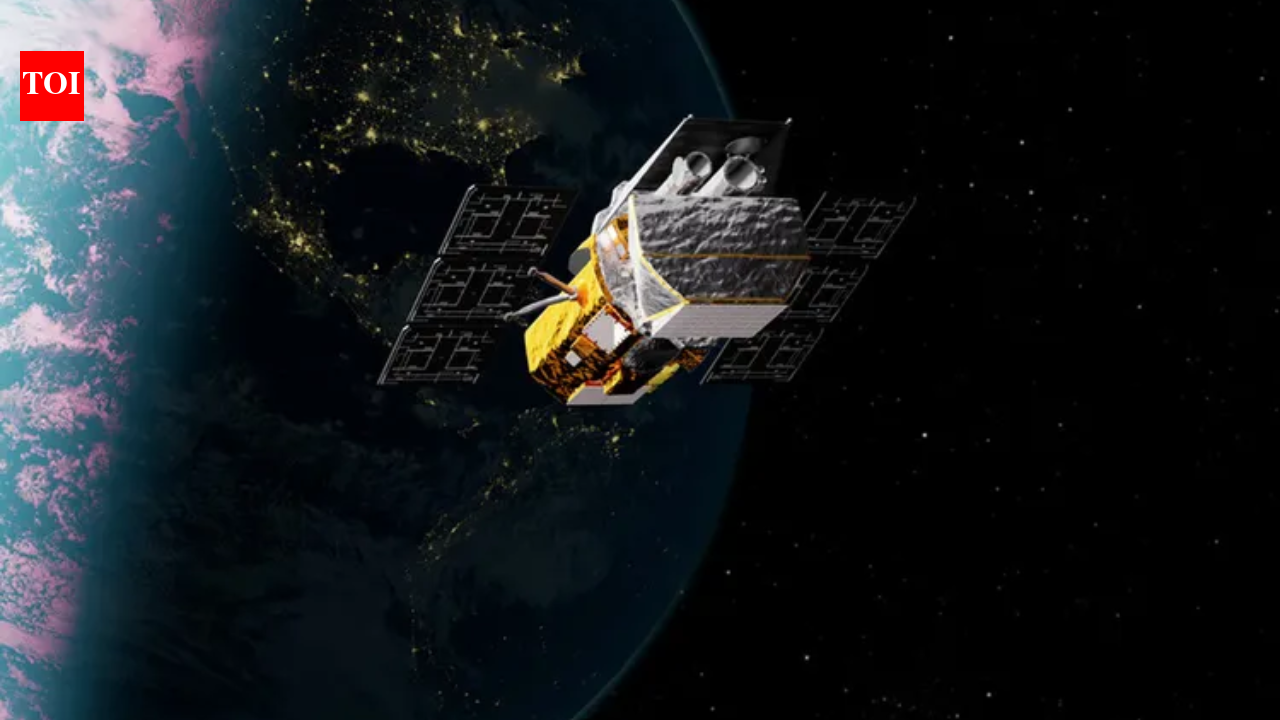
NASA’s 3,200-pound Neil Gehrels Swift Observatory has plunged back to Earth after nearly 22 years in orbit, bringing an end to a mission that transformed scientists’ understanding of some of the universe’s most powerful explosions. The space telescope re-entered Earth’s atmosphere over northern Sumatra, Indonesia, on November 4, 2026, after a failed attempt to save it from an uncontrolled descent. Although most of the spacecraft was expected to burn up during re-entry, NASA estimated that the possibility of someone on Earth being harmed by falling debris was approximately one in 2,100. The re-entry was tracked using US Space Force data, with NASA and the Aerospace Corporation monitoring its final descent.The observatory’s return was the culmination of months of concern over its deteriorating orbit. Launched on November 20, 2004, Swift was originally designed for a two-year primary mission. However, the spacecraft continued operating for almost 22 years, far exceeding its planned lifespan and becoming one of NASA’s most important tools for observing high-energy events across the universe.According to NASA, Swift’s re-entry was expected to take place at approximately 3:30 am Eastern Time on November 4, although the prediction initially carried an uncertainty window of around 11 hours. Tracking data subsequently placed its actual atmospheric re-entry at approximately 7:39 am EST over northern Sumatra.
Why did NASA’s Swift space telescope fall back to Earth?
The observatory’s descent was caused by the gradual deterioration of its orbit, accelerated by increased solar activity. As the Sun became more active, Earth’s upper atmosphere expanded, increasing atmospheric drag on the spacecraft. This resistance slowed Swift and caused it to lose altitude more rapidly.Unlike spacecraft equipped with propulsion systems capable of regularly correcting their orbits, Swift could not independently boost itself to a higher altitude. As the atmospheric drag increased, the observatory struggled to maintain a stable orbit.The problem became serious enough for NASA to explore an unusual rescue operation involving a private space company. In 2025, the agency hired Arizona-based Katalyst Space Technologies to develop a robotic spacecraft called Link, which was intended to approach Swift, capture it using robotic arms and push it into a higher orbit.The proposed operation was designed to extend the observatory’s scientific life by several years. However, the rescue spacecraft encountered technical problems shortly after its launch in July 2026. Link began spinning uncontrollably because of difficulties with its attitude-control system, preventing it from safely approaching and capturing Swift.The rescue attempt was eventually abandoned in August, leaving the ageing observatory without a viable way to escape its declining orbit. The mission, which cost approximately $30 million, was intended to demonstrate how robotic spacecraft could potentially service and rescue ageing satellites rather than allowing them to become space debris. Link itself subsequently re-entered Earth’s atmosphere in September.
Could debris from the telescope hit people on Earth?
Despite its considerable size, NASA said the likelihood of the spacecraft causing harm to anyone on Earth was extremely low. The agency estimated the risk of injury at approximately one in 2,100, a figure that accounted for the possibility of some components surviving the intense heat of atmospheric re-entry.Most of Swift was expected to disintegrate as it travelled through the atmosphere. However, NASA mission chief scientist Brad Cenko said that certain denser components, including parts made of tungsten and some mirror components, could potentially survive the descent.The surviving fragments were expected to fall into the ocean, although the possibility of debris reaching land could not be entirely ruled out. According to NASA’s re-entry assessment, the spacecraft’s relatively low orbital inclination restricted the possible re-entry locations of surviving fragments to a band between 20.6 degrees north and 20.6 degrees south latitude. This included parts of Africa, Australia, India, Southeast Asia and Central and South America.The US Space Force continued tracking the observatory as it approached Earth, while NASA monitored the predictions to assess the potential danger. There were no immediate reports of injuries or damage associated with its re-entry.
What did NASA’s Swift Observatory discover during 22 years in space?
Although its final descent attracted attention because of its size and the potential danger of falling debris, Swift’s scientific legacy was considerably more significant. The observatory was launched in 2004 to study gamma-ray bursts, extremely powerful flashes of energy associated with some of the most violent events in the universe. These bursts can occur when massive stars collapse into black holes or when certain compact stellar objects collide.Swift was designed to detect these fleeting explosions and quickly redirect its instruments towards their sources, allowing scientists on Earth and other observatories in space to investigate them before the signals disappeared.It carried three scientific instruments: the Burst Alert Telescope, which detected gamma-ray bursts; the X-ray Telescope, which studied their afterglows; and the Ultraviolet/Optical Telescope, which helped scientists examine the events at different wavelengths.According to reports by CBS News and Reuters, the observatory detected more than 2,000 gamma-ray bursts and approximately 1,400 supernovae during its operational life. Its observations also helped scientists investigate black holes, active galaxies, stellar flares, comets and asteroids. Its data contributed to thousands of scientific research papers, extending its influence well beyond its original mission.The spacecraft was initially named the Swift Gamma-Ray Burst Explorer. In 2018, it was renamed the Neil Gehrels Swift Observatory in honour of Neil Gehrels, its principal investigator, who died in 2017. Its ability to rapidly turn towards newly detected cosmic events made it an important early-warning system for astronomers. Other observatories, including the Hubble and later the James Webb Space Telescope, could use alerts from Swift to conduct more detailed investigations of these events.Its final scientific observation was made on October 20, 2026, before its systems were shut down as its orbit deteriorated further.Its observations have left astronomers with an extensive archive of information about high-energy cosmic phenomena, which researchers can continue analysing even after the spacecraft itself is gone. The failed rescue attempt has also renewed discussions about the future of satellite servicing and orbital debris management. As more spacecraft are launched into orbit and existing satellites age, the ability to repair, reposition or safely remove them could become increasingly important.NASA is also facing questions about the future of other ageing observatories, including the Hubble Space Telescope, whose orbit is gradually declining. The agency has been exploring ways to extend the operational life of existing spacecraft and prevent uncontrolled re-entries.