In March 2026, India was faced with an unprecedented oil supply and price shock. Four months from then, India has managed to successfully secure its crude supplies through a diversified procurement basket relying mainly on Russian crude to tide over the energy security situation.However, even as the Strait of Hormuz disruptions continue, India is now faced with the prospect of a fresh oil shock – and this time the impact may not be limited to Middle East supplies.Iran-backed Yemeni group, the Houthis, have threatened a maritime blockade on Saudi Arabia. What this essentially means is that Saudi Arabia’s crude oil exports are set to be hit. And India which gets a big portion of its crude imports from the Middle East country, is now staring at fresh supply disruptions amid Strait of Hormuz closure.
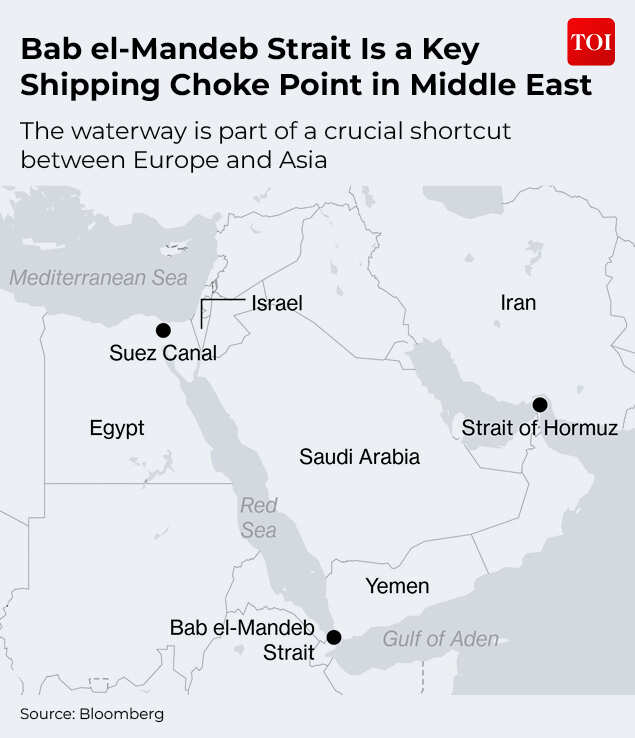
Why Bab el-Mandeb is important
The Houthis threat
The Houthis have said that the blockade is in response to what the group has described as Saudi Arabia’s siege of Yemen’s capital. The move comes at a time when the world is still recovering from the Strait of Hormuz supply shock that sent crude oil prices soaring globally. Even as the US-Iran conflict continues, crude oil prices have settled back to levels below $100, but persistent Hormuz disruptions and now the possible choking of Saudi Arabia’s oil exports may send them into an upward spiral again.The move adds to mounting concerns over energy supplies from the Middle East. Shipping through the Strait of Hormuz – through which roughly one-fifth of the world’s oil moved before the US-led conflict with Iran – remains close to a halt. Any disruption to traffic through the Red Sea, which Saudi Arabia currently relies on for the bulk of its crude exports, would hence further deepen the conflict’s impact on global oil trade.Following the outbreak of the war and Iran’s effective closure of the Strait of Hormuz, Saudi Arabia rerouted its crude exports through the Red Sea port of Yanbu.
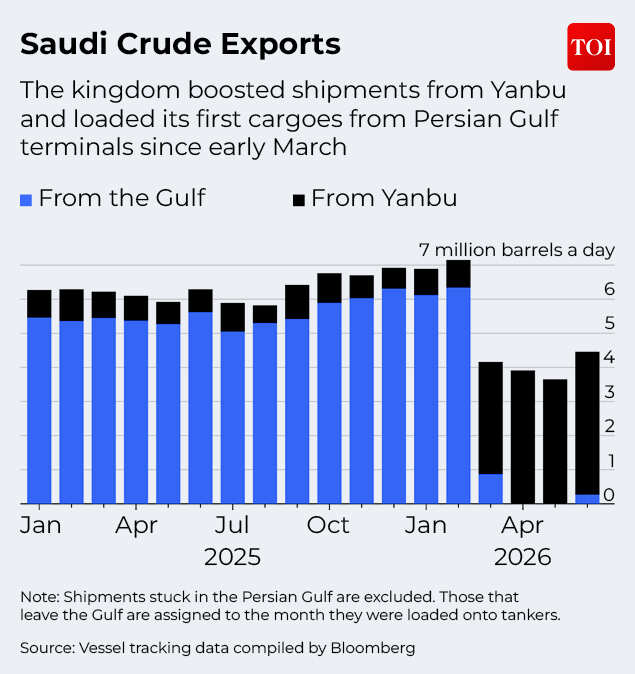
Saudi Exports Via Red Sea On The Rise
According to a Bloomberg report, shipments from the port were at a record 4.19 million barrels a day last month – a fact that has helped cushion the impact on global oil supplies. However, the route remains vulnerable because tankers using it are exposed to attacks by Houthis, who have previously targeted commercial shipping in the Red Sea.
Why is Bab el-Mandeb Strait important for Saudi Arabia & global crude supply?
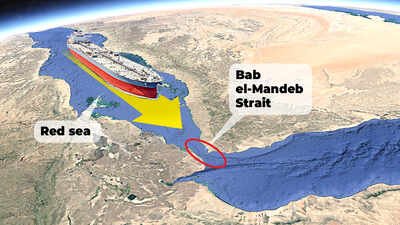
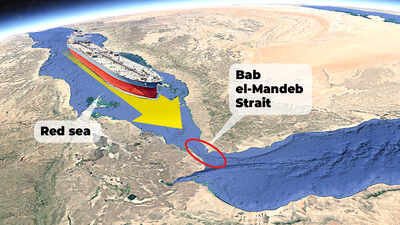
Like the Strait of Hormuz, the Bab el-Mandeb Strait is a strategically important maritime shipping route, and it has gained particular importance for Saudi Arabia since the US-Iran conflict as an alternate route to the Hormuz. With the Strait of Hormuz closed, Saudi Arabia has been directing a lot of its crude exports via the Bab el-Mandeb Strait, and India has been a major recipient of these shipments.The Bab el-Mandeb Strait is at the southern entrance to the Red Sea and connects the Indian Ocean with the Suez Canal. Its name means ‘Gate of Tears’ in Arabic – symbolic of the treacherous waters through which the ships make their way.
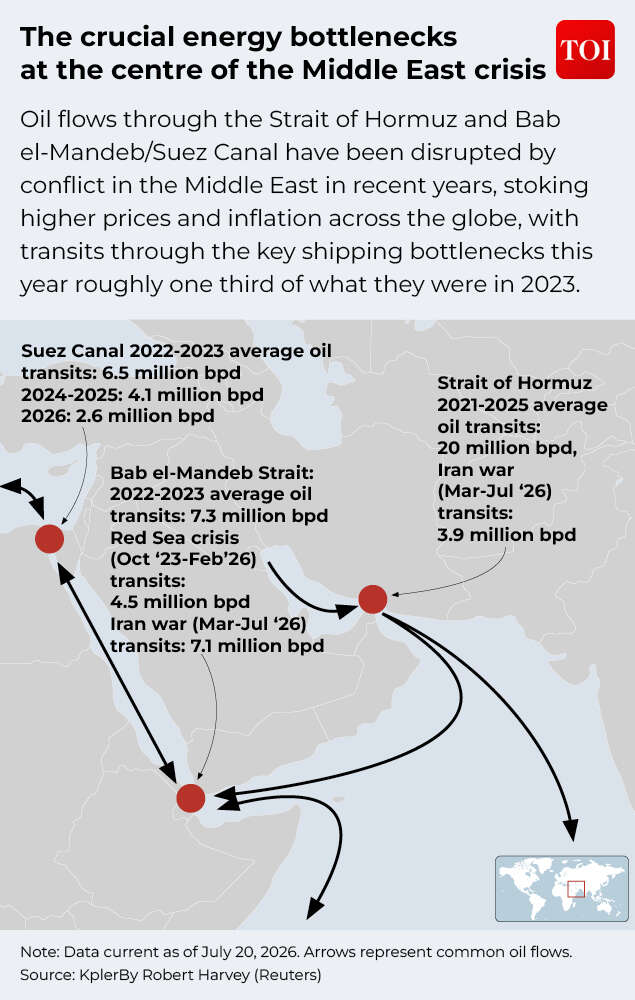
The crucial energy bottlenecks at the centre of the Middle East crisis
It is situated between Yemen on the eastern side and Djibouti and Eritrea on the western side. Until a few years ago, the Bab el-Mandeb Strait saw 15% of the global seaborne trade facilitated through it. Ships transiting through it usually carry crude oil, LNG, grains and consumer goods.However, traffic has fallen through it sharply since 2023 when the Iran-backed Houthis launched regular attacks on commercial vessels in the Red Sea. This forced many ships to reroute around the African continent.At present, ships passing through the Bab el-Mandeb Strait do not pay any transit fee. However, Lloyd’s List reported in April that the Houthis are examining proposals to levy tolls on vessels using the waterway, following Iran’s proposal to introduce similar charges in the Strait of Hormuz.
What it means for India
For India the impact may be multifold, depending on the severity of the disruptions and the length of the conflict.As the data quoted above suggests, Saudi Arabia has been one of the top three suppliers of crude oil for India since the US-Iran conflict began. Any chokehold on Saudi Arabia supplies will shrink India’s crude oil procurement pool, but experts note that Russian crude will continue to be the mainstay. Sumit Ritolia, Lead analyst, Modelling and Refining at Kpler tells TOI, “As of now, the threat appears to be directed at Saudi-linked shipping rather than the wider Red Sea, and shipping operations through the Bab el-Mandeb Strait remain normal. There is no immediate disruption to India’s crude imports, with the current impact largely limited to higher freight, insurance costs and market volatility.”However, if Ritolia cautions that if the threat expands into a wider Red Sea or Bab el-Mandeb disruption, Russian crude will also become India’s biggest concern. “Since the Strait of Hormuz disruptions, the Red Sea has become a critical corridor for Russian crude heading to India. Any prolonged disruption would directly affect India’s largest source of crude imports, increasing voyage times, freight costs and forcing refiners to seek more expensive alternative barrels,” he explains.However Prashant Vasisht, Senior Vice President and Co-Group Head, Corporate Ratings at ICRA notes that alternate routes to Red Sea will keep the supply going, albeit with a rise in freight and insurance costs. “If the Houthis block the Red Sea route then not just India’s crude oil supplies from Saudi Arabia, but also from Russia would be affected. Imports from Russia can continue through the Cape of Good Hope, but the transit times would be longer, increasing freight costs,” he tells TOI.The Cape of Good Hope is located at the southern tip of Africa. It is not a maritime chokepoint. But, it is definitely an important alternative shipment route for supplies between Europe and Asia. Ships sail around South Africa, using the open-ocean corridor that links major trade routes between Asia and the Americas. The ships that travel along this route tend to remain close to the African coastline to avoid the harsher sea conditions of the Atlantic and Indian Oceans. Unlike some major maritime passages, there is no transit charge for using the Cape of Good Hope.According to a Bloomberg report, shipping activity via the Cape of Good Hope typically sees a rise whenever geopolitical tensions make the Suez Canal, the Red Sea or the Strait of Hormuz unsafe. Recently, disruptions in the Strait of Hormuz have led to a surge in traffic around southern Africa, with vessel movements increasing by as much as 90%.But, as experts note, although the route provides a relatively safer option for global shipping, it comes at a significant operational cost, as detouring around the African continent adds several thousand miles to the journey.For India, the loss of Saudi Arabia’s crude oil supplies will not only be about scouting for alternative sources, but also the prospect of having to pay higher crude oil prices.“With Hormuz and Bab el-Mandeb Strait disruptions, Saudi Arabia which is a major oil supplier for the world and India will see its crude exports hit. This in turn would constrain global supply which could send crude oil prices soaring again. This would be an economic hit for India,” Prashant Vasisht explains.Analysts note that oil supplies remain normal as of now and India’s crude oil procurement has been aggressive in the last few months, placing it at relative comfort.But as Sumit Ritlolia points out: If the disruption broadens, Bab el-Mandeb could emerge as the biggest threat to India’s oil supply, even more than Saudi volumes, given India’s heavy reliance on Russian crude moving through this route.