
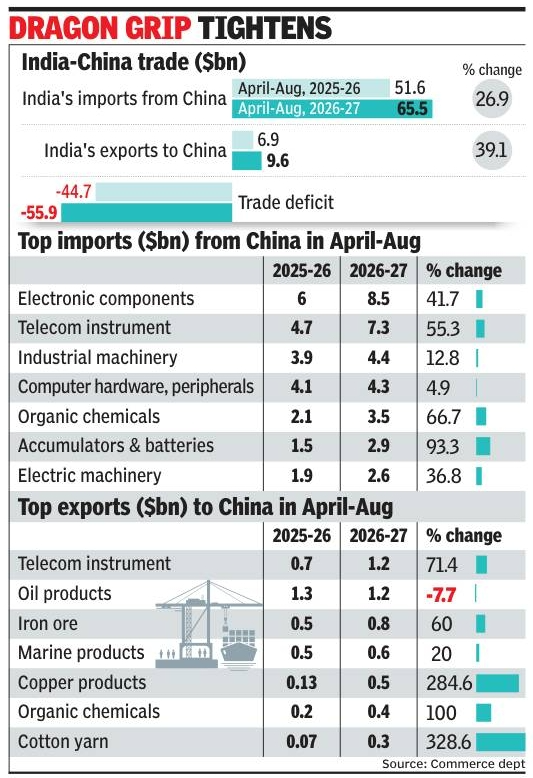
NEW DELHI: Every cheer for electric vehicle sales in the country also means that import of batteries from China goes up too given the complete dominance India’s neighbour enjoys in the global trade of this product.Not surprisingly, the spurt in the sale of EVs in India has resulted in import of batteries from across the border nearly doubling to $2.9 billion during April-Aug, making it the sixth largest import item from China so far this year, the latest commerce department data showed. The high growth has meant that it has overtaken electronic instruments, electric machinery, plastic raw materials and residual chemicals. With India and other countries failing to make any technological breakthrough, import of batteries is only going to surge. Indian battery makers, the few that have managed to set up shop after the PLI for the sector failed, in any case, are just packing the cells imported from China.
India-China trade
There are other areas of concern too. For instance, two-and three-wheeler imports have shot up to $107 million during April-Aug, compared with $2 million a year ago. Similarly, car imports are up 2.6 times to $226 million in the first five months of FY27 — probably led by BYD — from $87 million in the corresponding period last year. Even gold and silver imports have surged as have oil products (3x to $179 million), dye intermediates (2.6x to $338 million) and bulk minerals (3x to $180 million) but they remain small compared with electronics, machinery, chemicals and plastics that make up around three-fourth of imports from China.With its firm grip over the electronics and telecom value chain, higher production of mobiles, computers and other devices in the India has not led to imports of components and inputs from China shrinking in any way. Official data showed that telecom equipment, including mobiles, as well as electronic components have seen over 40% imports growth in the first five months, when trade deficit with China widened to nearly $56 billion as against $44.7 billion during April-Aug 2025. At this pace, it is set to cross the deficit for 2025-26, which was pegged at $112 billion.No wonder, finance minister Nirmala Sitharaman and commerce and industry minister Piyush Goyal have expressed a worry about it in recent days and last week both underlined the need for a “fair deal”. While Indian exports have increased 40% this year, a bulk of it is inputs, and on a small base with average monthly exports remaining below $2 billion during April-Aug (see graphic).For India to replace Chinese goods is tough given the cost advantages that come with economies of scale in addition to subsidies that are doled out. China is unwilling to cede any ground. “If you look at the way China’s been developing, it’s different from the way Japan and Korea did, where they moved up the manufacturing ladder. China is filling the entire spectrum; they don’t appear to be releasing the lower end. That’s blocking the countries below them from doing what China did,” S&P global chief economist Paul Grunwald told TOI in a recent interview.“While we talk of trade deficit, if China turns off the tap, several of our industries including pharma, electronics machinery and chemicals, will be severely hit. We need to create domestic capacity across industries and deepen local manufacturing in these sectors,” said Ajay Srivastava, founder of trade think tank GTRI. No wonder Indian industry petitions whenever govt puts import checks.