
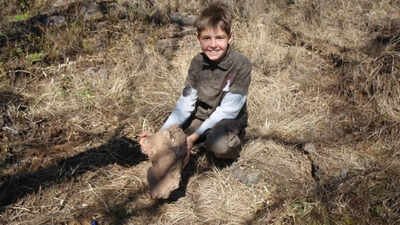
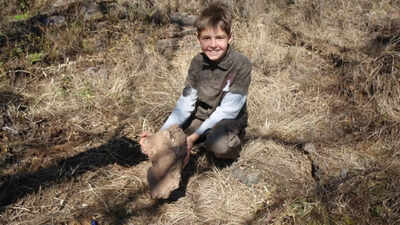
What started as a regular field trip with his scientist father turned into one of the biggest discoveries in human evolution research. At just nine years old, Matt Berger found fossils that later helped scientists identify a previously unknown human ancestor species.Most children spend school holidays playing outdoors. But for nine-year-old Matt Berger, one afternoon in South Africa turned into a discovery that would later make headlines in the scientific world.Matt was accompanying his father, Lee Berger, a paleoanthropologist who studies fossils of early human ancestors. As a child, Matt often joined his father on field trips and excavation visits.In August 2008, the two travelled to the Malapa Cave area near Johannesburg, part of the famous “Cradle of Humankind” World Heritage Site known for important discoveries linked to human evolution.At the time, Lee Berger was trying to identify unexplored cave sites using Google Earth. Many experts had started believing that no major human ancestor fossils were left to be discovered in Africa.
Field trip to major discovery
On the day of the discovery, Matt’s father reportedly told him to look around for fossils near the cave site.Soon, Matt began chasing his dog Tau, who had wandered away from the area. While running behind the dog, Matt tripped over a log. As he got up, he noticed a small fossil sticking out from a rock beside the path.“My dog started running away from the site. I started following him and I tripped on a log, and as I was getting myself up and dusting myself off, I noticed a little fossil in a rock on the side of this path,” Matt later recalled in an interview with the BBC .Matt called his father, who quickly realised the fossil was important. It was later identified as the fossilised collarbone of a hominid, a group that includes humans and their ancient relatives.
New human ancestor species
As scientists examined the rock further, they found more remains, including a jawbone with teeth.The fossils were eventually identified as belonging to a previously unknown species called Australopithecus sediba, which lived nearly two million years ago.Two weeks later, Lee Berger and his research team returned to excavate the site. They later recovered partial skeletons believed to belong to an adult female and a young male.Some researchers believe Australopithecus sediba may be closely linked to the evolutionary line that led to modern humans.
From early hominins to modern humans: A quick overview
Human ancestors are studied in a field called paleoanthropology, which uses fossils to understand how humans evolved over millions of years. These early species are known as hominins. One of the most important early species is Australopithecus afarensis, best known from the “Lucy” fossil discovered in Ethiopia. It lived over 3 million years ago and showed evidence of walking on two legs. Another key species is Homo habilis, linked with early stone tool use and found in Africa. Homo erectus appeared later and is believed to be among the first human ancestors to move out of Africa. Modern humans, Homo sapiens, evolved much later and are the only surviving human species today.