

US President Donald Trump has time and again said that he ‘loves’ Indian talent – but he doesn’t seem to want it in America – or so his policies suggest. Indians’ big American dream is facing fresh hurdles every other month.For years, the path has been established – study in the US, get a job there, and eventually vie for a green card for permanent residency. That dream is slowly turning into a nightmare with frequent policy changes, immigration restrictions, heightened uncertainties.From heightened checks for students looking to enroll in American colleges to the new selection process for H-1B visa professionals and now the green card scrutiny, every step towards a secure future in the US is now riddled with problems, complexities, and above all uncertainty.
The path turns unpredictable
Students are facing greater scrutiny of visa applications with social media activity now under check. There are also some proposed changes in works for student visa categories that may put a fixed time on the stay under the student visa category. Experts point to processing delays, uncertainty surrounding work authorization, and challenges in transitioning from student status to long-term employment.
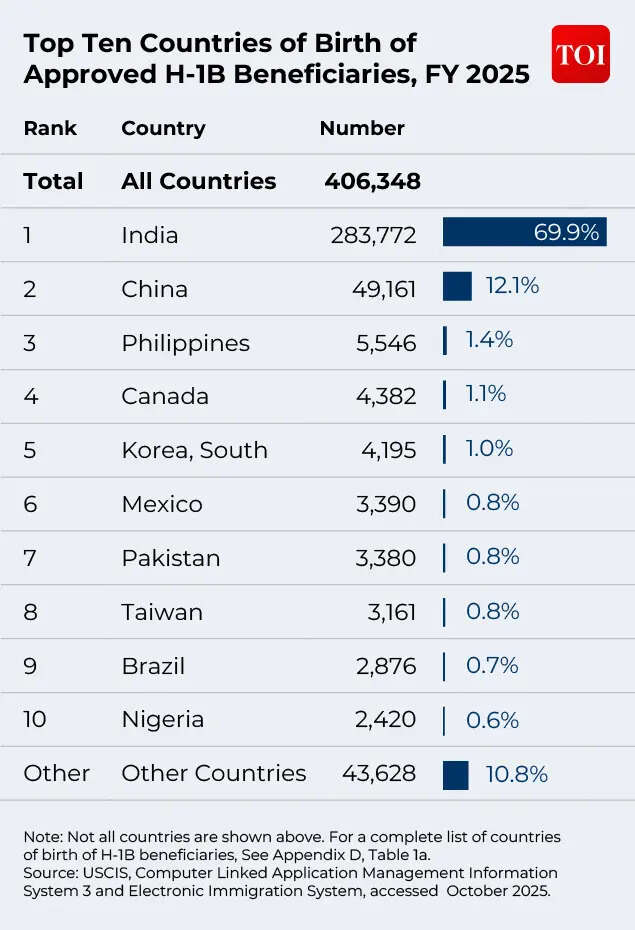
Top Ten Countries of Birth of Approved H-1B Beneficiaries, FY 2025
The H-1B visa remains the main route for Indian professionals seeking high-skilled jobs in the US. A recent report on H-1B workers by the US Department of Homeland Security says, “Of the H-1B petitions approved in FY 2025, 70 percent were for beneficiaries whose country of birth was India, indicating a high concentration of approvals in a single foreign labor market. The second most common country of birth was China, accounting for approximately 12 percent of all beneficiaries.”Trump imposed a $100,000 fee on new H-1B applications last year and instead of a lottery system for picking visa aspirants, a weighted system is being put in place. A US court has recently struck down the fee, ruling that it amounts to an unauthorized tax. But the verdict is likely to be appealed, adding a big layer of uncertainty to this popular route.
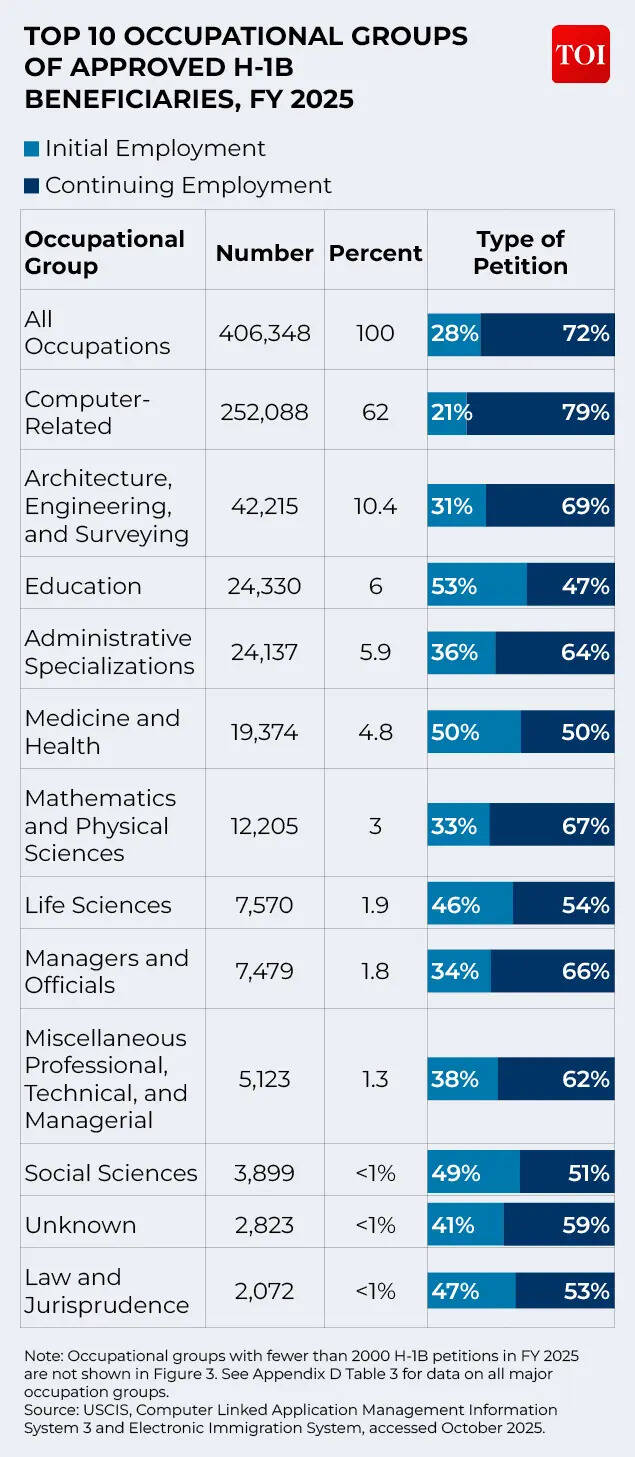
Top 10 Occupational Groups of Approved H-1B Beneficiaries, FY 2025
Kuldip Kumar, Partner, Mainstay Tax Advisors says that skilled professionals seeking employment in the United States are facing challenges. “Increased scrutiny of visa petitions, higher filing costs, evolving compliance requirements, and a greater focus on protecting domestic employment have made the immigration process more complex and less predictable,” he tells TOI.As Rajiv Dabhadkar, Founder, National Organization For Software and Technology Professionals points out: the H‑1B was never an open invitation. It was always tightly controlled. What has changed is unpredictability.
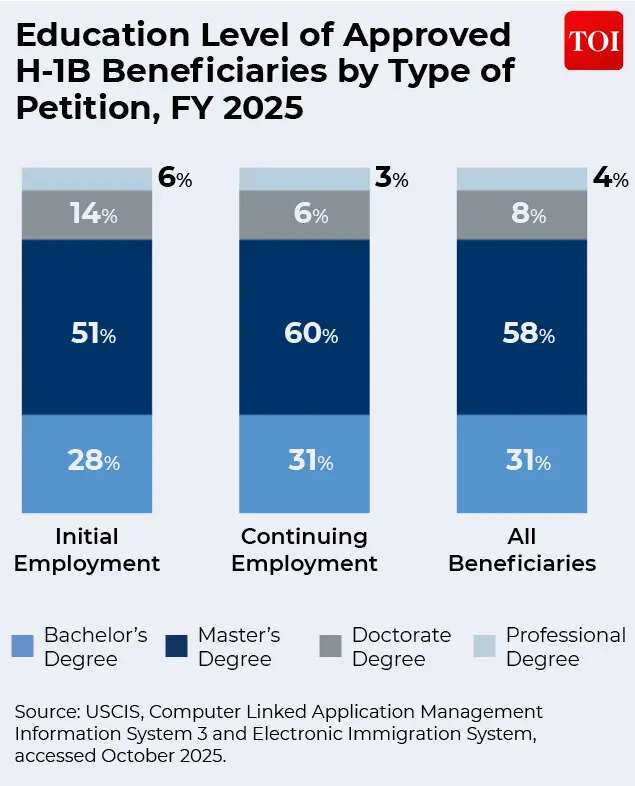
Education Level of Approved H-1B Beneficiaries by Type of Petition, FY 2025
“Workers can handle hard rules, but they can’t plan careers around random policy changes, fee increases, and unstable processing. That uncertainty is a new kind of risk,” he says.Similarly, green card aspirants, particularly those from countries with significant employment-based immigration backlogs, continue to face lengthy waiting periods.
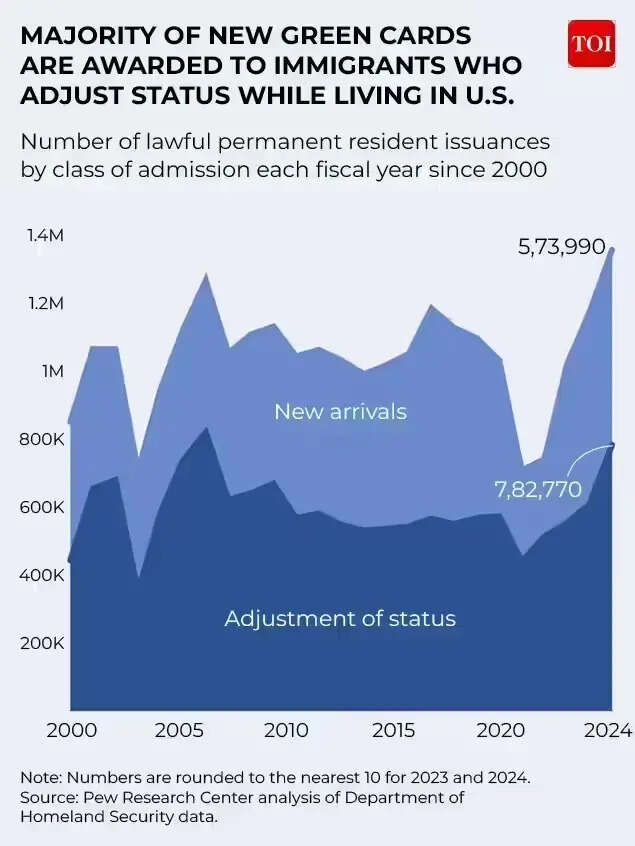
Majority of new green card holders are awarded to immigrants who adjust status while living in US
Add to that: a recent USCIS memo has sparked concern among immigrants by suggesting that temporary visa holders seeking green cards may need to return to their home countries to complete the process. This has raised fears about the future of the Adjustment of Status (AOS) pathway that allows applicants to obtain permanent residency without leaving the US. Although the administration later clarified that there was no blanket policy change and that AOS remains available, immigration experts say the guidance gives officers greater discretion and could lead to increased scrutiny of applications. “Combined with policy uncertainty and evolving immigration rules, these delays have made the path to permanent residency longer and more challenging than many had anticipated,” Kuldip Kumar, a specialist in global mobility and cross-border taxation matters says.
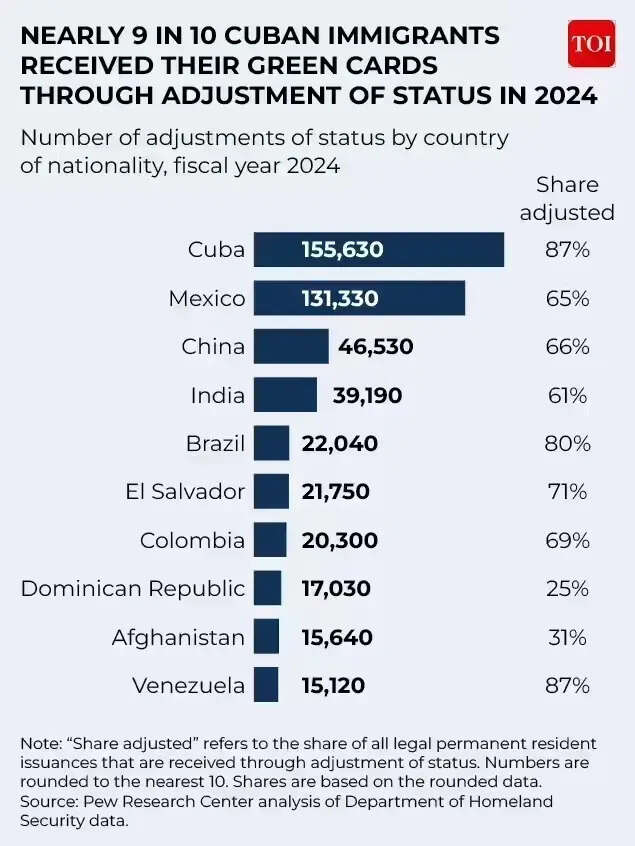
Where India stands: Country-wise adjustment of status
The development is particularly significant for Indians, who account for a large share of employment-based immigrants and H-1B holders and often rely on AOS while navigating lengthy green card backlogs. While most experts believe H-1B workers may see limited direct impact because of the visa’s dual-intent nature, the episode has heightened uncertainty around legal immigration pathways, with businesses, students and families worried about a more unpredictable immigration environment. And then there are also worries about the recent instances related to anti-India racist sentiment.
Alternative destinations & India
Experts note that several other countries can work to be alternative destinations, depending on your study and work fields. Budding opportunities in India may also help the country retain talent.“Recent changes in immigration policies and the broader approach towards immigration have made moving to the US more challenging and expensive. As a result, many individuals are increasingly exploring alternative destinations that offer more predictable immigration systems, easier pathways to permanent residency, and a lower cost of living,” Kuldip Kumar says.However, he still believes that given the opportunities that the US offers, it will likely remain one of the most sought-after destinations for global talent despite these challenges.Sebin Jinny, Partner at Vialto Partners says Germany, Australia, Singapore, UAE, Canada, UK are serving to be meaningful alternatives.“Germany has emerged as one of the more compelling alternatives, particularly for Indian engineers, IT professionals, healthcare workers, and manufacturing specialists. Australia and Singapore continue to hold their ground as preferred destinations, whether for higher education or skilled migration,” he tells TOI.“The UAE occupies a different but equally compelling lane. It has long been a practical and culturally familiar choice for Indians seeking a better quality of life without the weight of high taxation. The UAE Golden Visa, which functions much like a permanent residency and can be secured through investment thresholds among other criteria, has made it particularly attractive for entrepreneurs and high-net-worth individuals,” Sebin adds.For Sebin Jinny, what ties all of this together is a broader structural shift that is still unfolding. “India is actively signing Free Trade Agreements with multiple nations, and the prospect of an India-EU FTA, arguably the most consequential trade agreement India has pursued, could meaningfully reshape how Indian professionals access European labour markets in the years ahead,” he says.He also notes that US immigration is tightening up at a time when India is probably better placed than ever to absorb the talent that would’ve otherwise left and never come back.“GCCs in Bengaluru, Hyderabad, even Pune have quietly moved up the value chain. They’re not just executing anymore. Once the work itself becomes meaningful locally, the visa question stops being purely aspirational and starts becoming a genuine trade-off. Not everyone will choose India, but the default answer of “going overseas” is no longer automatic and increasingly, it doesn’t point in just one direction,” he says.
What does it mean for your American dream?
Experts believe that the ladder isn’t broken, but it does have a few steps missing!Rajiv Dabhadkar says that a US degree still has big value and American universities lead in research. “But when staying in the US after graduation is uncertain, families worry. Is this expensive move safe? For many, the answer is no longer obvious,” he says.For green card hopefuls, the biggest damage is psychological. Skilled immigrants accepted short-term hardship because they expected a long-term payoff. Very long waits — sometimes decades for Indians — have broken that promise. “If the wait is longer than a career, the deal is void. Many skilled Indians have realized that and made different plans,” Dabhadkar says.Right now, Manish Daftari, Partner, Vialto Partners sees the biggest impact for students coming in the form of increased administrative burden associated with having to extend their student visa status every four years. Manish Daftari tells TOI, “We are not currently seeing an increase in denials for student, professional, and green card aspirant visas, which is encouraging. That said, there are a number of ways each of these groups are being impacted by new and evolving immigration policies.”Professionals and green card aspirants face a different challenge, as changing immigration regulations have increased the prevailing wage for employees on H-1B visas, a move that will likely discourage employers from sponsoring foreign nationals. “And overall, visas are being denied for people who have a prior criminal violation, including for minor infractions. Taken together, these new policies are making it increasingly harder for non-US citizens to live and work in America,” Manish Daftari says.According to Rajiv, for people in cutting-edge fields such as AI, chip design, biotech, advanced engineering, and top research, the US still offers the best pay, institutions, and funding. That won’t change soon.“But, for others, the advantage has shrunk. High housing costs, healthcare, childcare, and visa uncertainty, compared with improving Indian cities and more remote work, mean the benefits are less clear. People now ask whether life in the US — not just higher salary — is worth the move,” he says.He sums the situation up: The “American Dream” for Indians was never only about getting rich. It was about predictability. It was about the idea that working hard now would lead to security later. Go to school, get a job, get an H‑1B visa, get a Green Card, become a citizen. A ladder with clear steps.That ladder hasn’t fallen down. But some steps are missing now, and people climbing it aren’t sure where it leads.