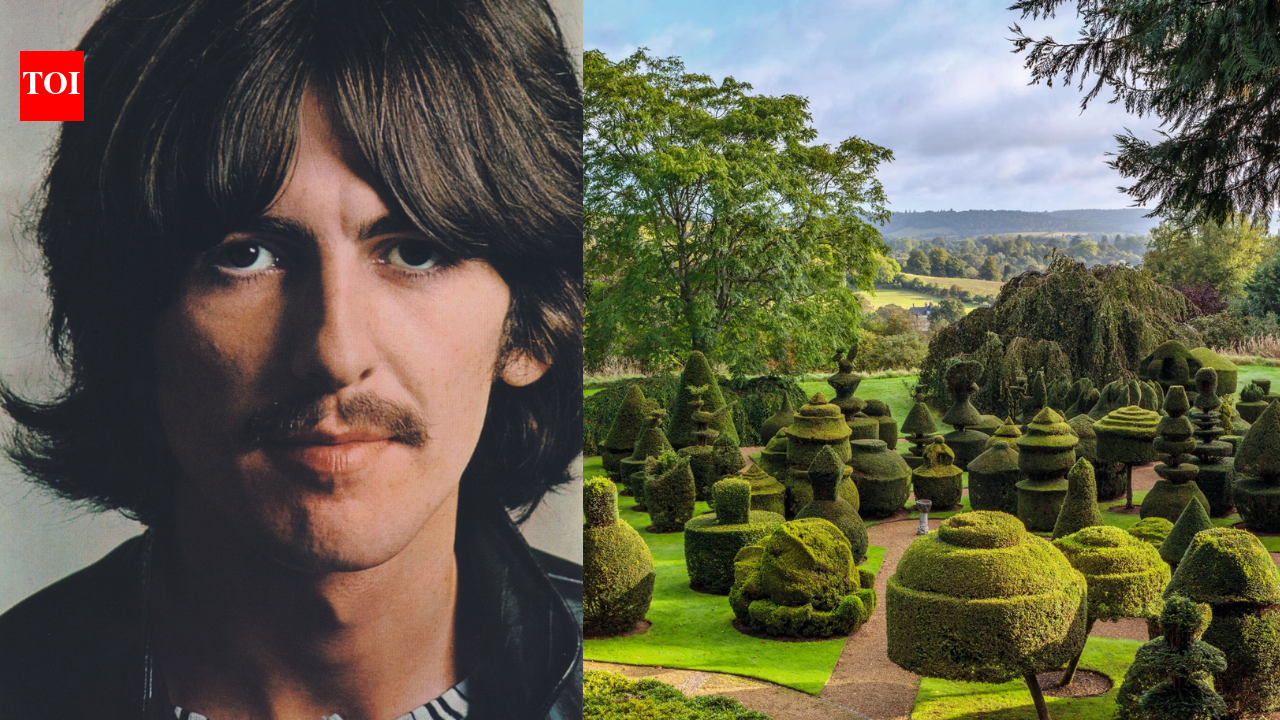
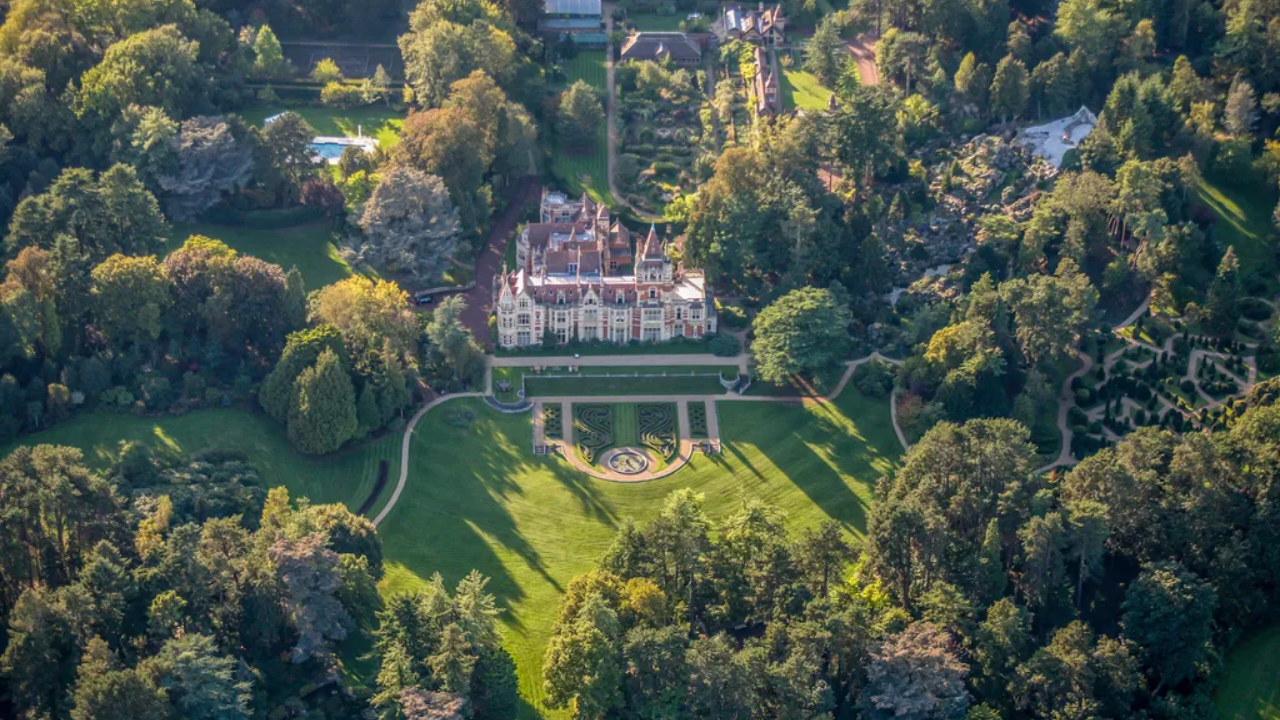
In 1970, George Harrison bought Friar Park and discovered a grand Victorian estate whose once-famous gardens had fallen into neglect. Weeds, ivy and brambles had taken over parts of the grounds, the lake needed repairs, and the carefully shaped yews had grown into dense, unruly masses. Harrison set about restoring the landscape, clearing vegetation and bringing damaged features back into use. Gardening soon became part of daily life at the estate, shared in different ways with his family. After Harrison’s death in 2001, Olivia Harrison continued caring for Friar Park, helping restore its topiary and preserve the strange, elaborate character of its historic gardens.
Friar Park became an elaborate Victorian garden experiment
Long before George Harrison arrived, Friar Park had gained a reputation for its unusual gardens. The house, built in the 1870s and later enlarged, was transformed by Sir Frank Crisp, a solicitor and keen collector who developed the grounds between 1889 and 1919. His creations included a vast rock garden, grottoes, caves, underground passages and a miniature Matterhorn. In the Dial Garden, sundials replaced the fountains of a Versailles labyrinth-inspired layout. Yews were trained into columns, spirals, birds and other fanciful forms, blending plants with sculpture and inscriptions. The estate also welcomed visitors, while postcards carried its curious gardens beyond Oxfordshire.
Friar Park’s gardens began to decline after the war
According to Country Life (British Magazine), after Sir Frank Crisp died in 1919, Friar Park passed to banker and Chinese porcelain collector Sir Percival David. The gardens remained cared for and continued welcoming visitors until the Second World War. The postwar years brought mounting costs and taxes that made large estates increasingly difficult to maintain. In 1951, Friar Park was purchased by the Salesian Sisters of St John Bosco, who established a convent school on the property. The nuns continued trimming the yews, but maintaining the extensive grounds proved costly. Plans to divide the land for development failed, leaving the sisters to put the estate back on the market.
George Harrison arrived in 1970
By the time Harrison bought Friar Park, the estate was far removed from the carefully maintained garden associated with Crisp. Harrison was already an internationally known musician, but the property gave him somewhere to pursue interests away from the recording studio and concert stage.The house itself required substantial repairs. Harrison later described finding parts of it deteriorating and recalled efforts being made to demolish it. He eventually helped secure its preservation as a listed building.The grounds were in an equally poor state. The lake had been used as a dumping place, while years of neglect had allowed weeds, ivy and brambles to spread through the planting. The topiary garden was particularly difficult to navigate. The old yews had expanded into dense masses, obscuring the original arrangement.Olivia Harrison said that he used garden flame-throwers to tackle some of the undergrowth and brought in two goats to help clear weeds and brambles from the rock garden. Local builders were employed to clean the lake and repair its infrastructure, including leaking areas and pipework.
The neglected yews slowly returned to shape
Once the worst of the vegetation had been removed, the structure of the topiary garden began to emerge again. Some of the yews had become almost tree-like, but the plants could withstand severe pruning.Harrison and Olivia worked on different parts of the grounds and gradually re-established the garden. New topiary forms were introduced over the years, although many of the plants were initially kept to relatively restrained shapes such as cones and columns.Gardening became part of family life at Friar Park. Their son Dhani Harrison later recalled his father spending so much time outside planting trees that, as a young child, he largely associated him with gardening rather than music.
PC: Country Life
Olivia Harrison continued the work
George Harrison died in 2001, but Friar Park did not become a frozen memorial to him. Olivia Harrison took on an active role in maintaining and developing the grounds.She continued adding plants and overseeing the wider estate, while also looking for ways to bring greater definition back to the topiary. Specialist topiarist James Crebbin-Bailey was brought in to work on the yews and box plants.His work went beyond simply keeping the existing shapes trimmed. Traditional forms were retained, while newer designs appeared among them, including geometric shapes and more unusual arrangements. Groups of plants were shaped into forms that sit somewhere between conventional topiary and the playful character associated with the original garden.
More than 160 plants now fill the restored topiary garden
The sundials provide one of the clearest reminders of how much was lost. Many of Crisp’s original collection had disappeared through sale or theft, and replacements have since been assembled to restore some sense of the Dial Garden.The topiary survived in a different way. Even after years of neglect, the yews could be recovered because of their ability to regenerate after hard cutting. That made it possible to work from the remnants rather than starting the garden again from scratch.Today, the topiary contains more than 160 yew and box specimens, according to estimates cited by Country Life. Most are yew, with a smaller number of box plants. Their forms vary from familiar cones and spirals to more unusual geometric and flowing shapes.
Friar Park remains a private estate
Harrison’s connection with Friar Park went beyond owning an unusual country house. The estate became part of his working life as well as his home, and he recorded music there during his years at the property.Yet the gardens have developed their own history alongside the music associated with the house. They began with Crisp’s Victorian experiments, survived years of reduced care under later owners, and were gradually recovered after Harrison purchased the estate.