Alaska’s Hawadax Island, once known as Rat Island, offers one of conservation’s clearest success stories. Invasive Norway rats, accidentally introduced by 18th-century shipwrecks and wartime shipping traffic, wiped out nesting seabirds and unravelled the island’s rocky intertidal food web for two centuries. In 2008, scientists carried out a full eradication, removing every rat from the island. Eleven years later, a 2021 study titled ‘Indirect effects of invasive rat removal result in recovery of island rocky intertidal community structure’ in Scientific Reports confirmed seabirds had returned, and with them, a kelp-rich intertidal ecosystem resembling untouched islands nearby.
Invasive rats devastated Hawadax Island’s seabird population
Norway rats reached the Aleutian Islands through 18th-century shipwrecks and World War II military activity, eventually overrunning dozens of islands in what became known as the “Rat Islands.” On Hawadax, the rats became a new apex predator, preying heavily on shorebird eggs and chicks. Breeding seabird populations collapsed, removing the island’s main check on herbivorous intertidal invertebrates like snails and limpets. Freed from predation, these grazers multiplied and stripped away fleshy algae and kelp. Researcher Carolyn Kurle and colleagues documented this rat-dominated baseline during 2008 surveys, capturing a shoreline ecosystem badly out of balance before any restoration work began on the island.
How the 2008 rat eradication on Hawadax Island started
According to Island Conservation, in 2008, a coordinated eradication effort led by Island Conservation, the US Fish and Wildlife Service, and The Nature Conservancy removed invasive rats from the island entirely, and it was renamed Hawadax, reviving its original Aleut name meaning “the island over there with two knolls.” The project gave researchers an unusual opportunity; they had pre-eradication data from 2008, allowing direct comparison against later surveys. Follow-up visits in 2013 showed early signs of recovery, while a comprehensive 2019 survey, five and eleven years after removal respectively, let scientists track the island’s ecological trajectory against neighbouring islands that had never hosted rats at all.
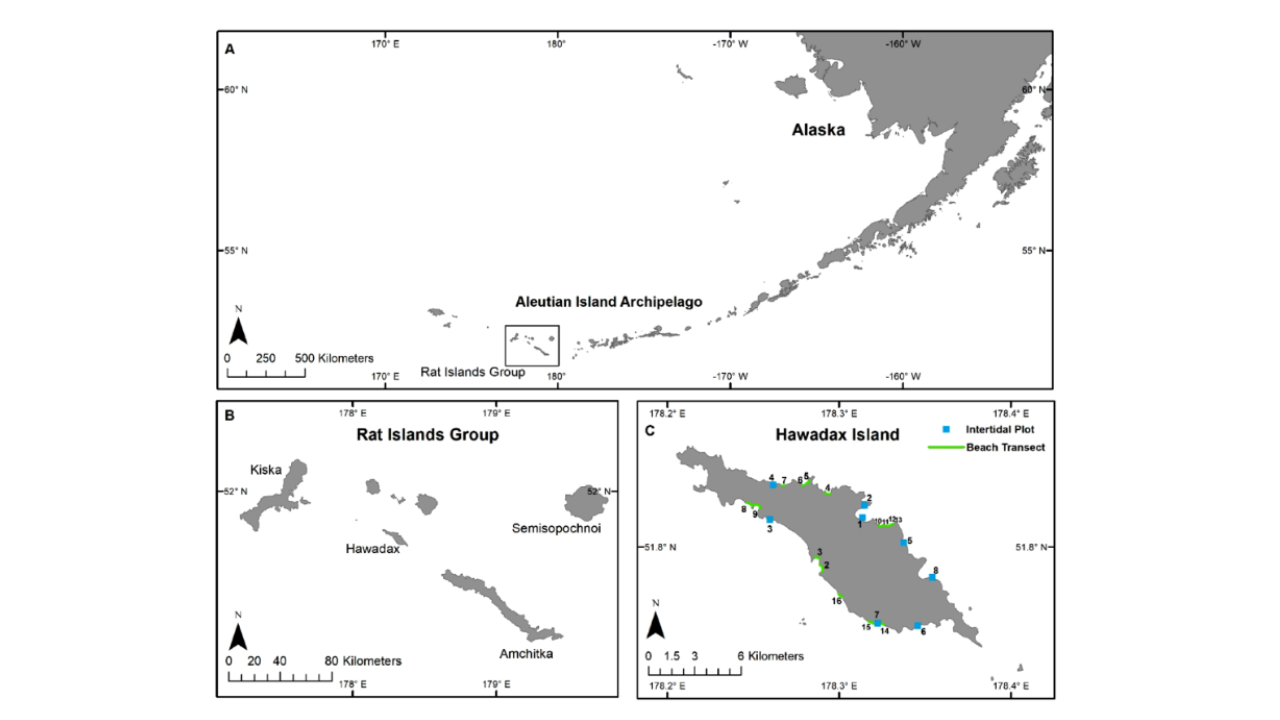
The (A) central Aleutian Archipelago, Alaska, USA, contains the (B) Rat Islands Group, including Hawadax Island. The (C) intertidal plots and beach transects were surveyed on Hawadax Island. Intertidal plot 6 was only surveyed in 2008 and 2013 (Image: Carolyn M. Kurle1)
The seabirds return and rebuild the food web
With rats gone, native shorebirds such as black oystercatchers and rock sandpipers began nesting successfully again, rebuilding populations that had nearly vanished under rat predation. As seabird numbers climbed, they resumed their historic role as apex predators of the rocky intertidal zone, once again consuming snails, limpets, and other herbivorous invertebrates in large numbers. This reestablished a three-level trophic cascade birds, invertebrates, algae, that had been disrupted for over two centuries by the rats acting as an unnatural fourth predatory tier. Lead author Carolyn Kurle noted the team expected recovery to take longer, calling the pace of the seabird rebound genuinely surprising. “We were surprised that the level of recovery unfolded so quickly, we thought it could be longer,” she said.
Kelp ecosystem recovery confirms the chain reaction on trophic levels
As invertebrate grazing pressure fell, fleshy algae and kelp cover expanded significantly across Hawadax’s shoreline, and by 2019 the intertidal community closely resembled that of islands that had never been invaded by rats. The Scientific Reports study, led by UC San Diego’s Carolyn Kurle with researchers from UC Santa Cruz, Island Conservation, and federal agencies, called it a rare, measurable example of conservation success. Co-author Donald Croll noted the work confirms how deeply introduced predators can reshape entire island ecosystems, while also showing the scale of benefits removal can deliver. The findings offer strong evidence for continued rat-eradication efforts on invaded islands worldwide, from remote Alaska to the tropics.