
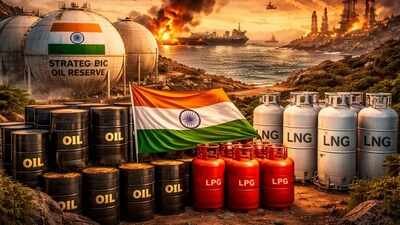
Even as it focuses on building its strategic petroleum reserves, India is now looking to build emergency liquefied natural gas (LNG) reserves. The plan is to have storage at import terminals by allowing operators to recover the costs through higher regasification charges, according to people familiar with the discussions.Requiring terminal operators to create additional storage capacity could enable the country to build strategic gas reserves more quickly than if the government were to fund and implement the project on its own.The disruption to LNG shipments through the Strait of Hormuz during the Iran conflict highlighted India’s exposure to supply disruptions, prompting the government to revisit the idea of creating strategic gas reserves. Although the proposal has been examined in the past, it was not pursued because of the substantial costs involved.Also Read | 145% rise in LPG imports: Gas buys to be doubled from US – how much can it help India cut reliance on Gulf supply?
Plans for LNG storage
Instead of establishing strategic storage facilities in depleted gas fields, an option considered prohibitively expensive, policymakers are evaluating a plan under which LNG terminal operators would be required to expand storage capacity at their existing import facilities, the people said. A final decision is yet to be taken, and the extent of the additional storage that operators may have to create is still under consideration, according to an ET report.Rather than financing the expansion through government expenditure, the Centre is examining a mechanism that would allow terminal operators to recover their investment by increasing regasification tariffs. The higher charges would then be passed on by gas importers to consumers further along the supply chain.At LNG import terminals, imported liquefied natural gas is converted into natural gas before being injected into the country’s pipeline network. For providing this service, terminal operators currently levy regasification charges of around Rs 65-80 per mmBtu.However, some cautioned that most LNG import terminals in India are already operating well below their capacity, and any additional costs imposed on importers could further reduce terminal utilisation and dampen domestic demand for natural gas.The government has also been encouraging private-sector participation in the development and operation of strategic crude oil reserves as a way to reduce the fiscal burden.
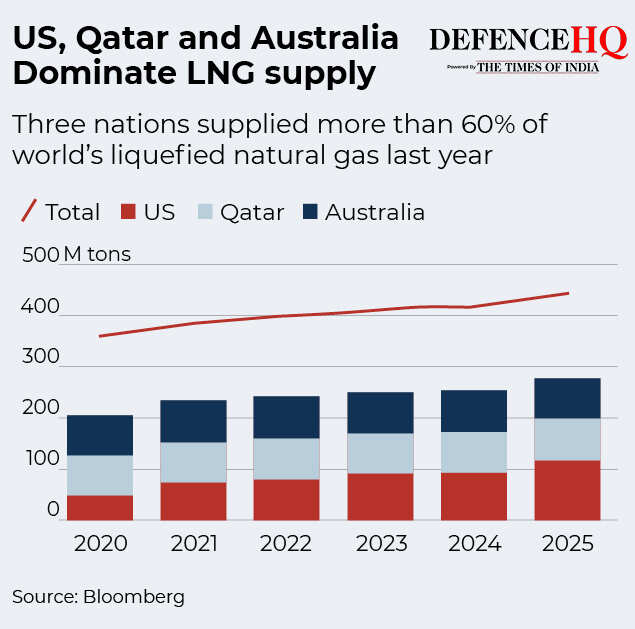
US, Qatar and Australia dominate LNG supply
Explaining India’s approach to strategic petroleum reserves, Oil Minister Hardeep Singh Puri recently wrote, “You do not run a country off a few caverns, because energy locked underground earns nothing and costs a great deal to hold.”Also Read | Hormuz oil shock sends India back to Russia: Is this a peak or the new normal?
LPG reserves also in focus
Meanwhile, India is stepping up efforts to diversify its sources of Liquefied Petroleum Gas (LPG), with the United States emerging as its largest supplier in the months following the outbreak of the Middle East conflict. India relies heavily on the Gulf for LPG imports, and the disruption to shipping through the Strait of Hormuz since March had a far greater impact on cooking gas supplies than on crude oil imports.Alongside the US, India has expanded LPG sourcing from countries such as Argentina, Nigeria and Malaysia.Oil marketing companies are now looking to increase LPG imports from the US beyond the current level of around 2.2 million tonnes a year as part of a broader strategy to diversify supply sources and reduce dependence on the Gulf.In May, the petroleum ministry asked oil marketing companies to prepare a roadmap for creating a strategic LPG reserve capable of meeting 30 days of demand. Increasing imports from the United States, along with expanding procurement from other countries, is expected to support this objective.The proposed strategic reserve will be in addition to the existing 45-day rolling stock that oil marketing companies already maintain to meet demand for both domestic and commercial LPG cylinders.