


In a job market that sees frequent headlines of layoffs, the emerging hiring trends hold significance, particularly for entry-level placements. A new report by Deloitte India suggests that the journey from internship to a Pre-Placement Offer, or PPO is becoming increasingly important.For students who are entering the job market, an internship is no longer just a line on their resume. It can be the first real test of whether a company sees them as a potential full-time employee.“Internships are increasingly evolving from a short-term assessment mechanism into a strategic talent pipeline. Our Campus Workforce Trends 2026 study shows a roughly 6% increase in PPO conversions and growing organisational investment in apprenticeship and internship programmes,” says Neelesh Gupta, Partner, Deloitte India.What does this mean for the job prospects of freshers – B.Tech, M.Tech, BBAs, MBAs? Let’s dive deep:
The changing trend
According to Deloitte’s Campus Workforce Trends 2026 report, the overall pre-placement offer conversion rates have increased by approximately 6% YoY. The report attributes this to stronger adoption of internship-to-hire programmes and sustained demand for pre-assessed campus talent.The report says that organisations are increasingly leveraging internship-to-hire programmes to improve hiring efficiency, retain proven talent and reduce external hiring risks.In fact, according to the report, the PPO conversion rates have improved across all major programmes; be it MBA or B.Tech.
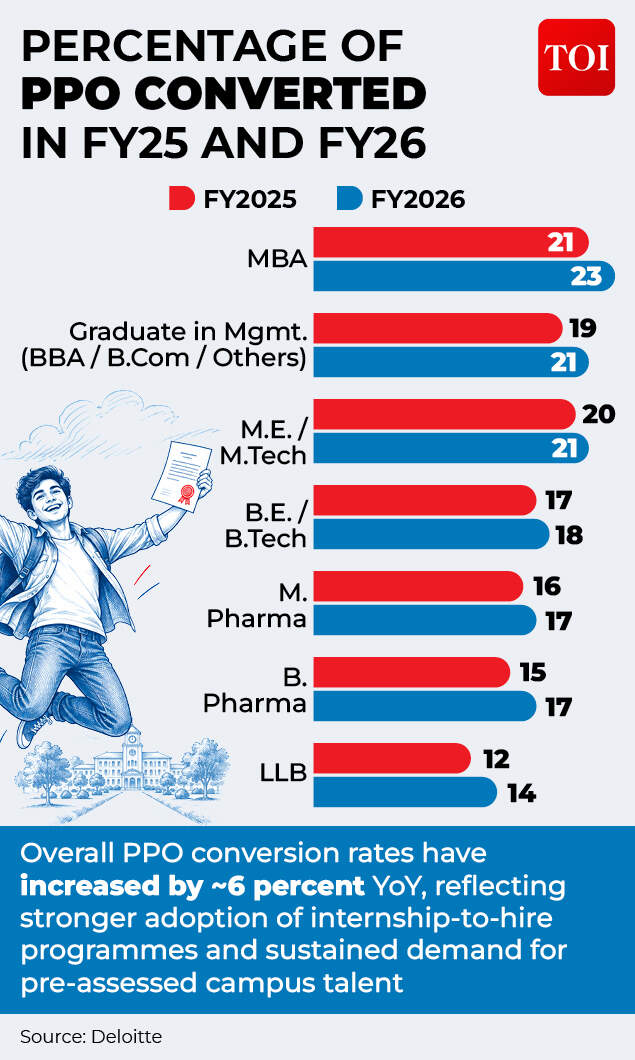
Percentage of PPO converted in FY25 and FY26
According to Deloitte’s Neelesh Gupta, 65-70% of organisations invest in structured apprenticeships and long-term internships to improve practical exposure and conversion outcomes. The main play for internship to PPO conversion is to lock in talent in the first or the second trimester (or initial part of their course) after assessing the candidate for an elongated period of 2 months instead of just a performance in an interview.“Thereafter, plan for structured acclimatisation and onboarding during the balance of the course. Please note that once a student is offered a PPO by an organization, he / she is signed out from the campus placement process by their institution and therefore cannot apply for placement in any other organization (ergo lock in),” he tells TOI.According to the Deloitte expert:MBA graduates continue to command the highest internship stipends, with median stipends of approximately:
- Rs 1.8-1.9 lakh/month at Top 10 institutes
- Rs 1.2-1.3 lakh/month at Tier 1 institutes
- Rs 55,000-75,000/month at Tier 2 institutes
- Rs 26,000/month at Tier 3 institutes
Engineering graduates (B.E./B.Tech and M.E./M.Tech) receive the second-highest stipend levels:
- Rs 90,000-1.2 lakh/month at Top 10 institutes
- Rs 60,000-80,000/month at Tier 1 institutes
- Rs 30,000-45,000/month at Tier 2 institutes
- Rs 15,000-25,000/month at Tier 3 institutes
Neeti Sharma, CEO at TeamLease Digital sees this as a shift from “hire and train” to “test and hire.” Companies want to see how a candidate performs in a real work environment before making a full-time commitment.“Hence, many companies today are using the internships or apprenticeships as a route to identify the right candidate early on, train them on the job and make this cohort part of their future workforce plan,” she tells TOI.“About 80% of employers, including many GCCs, are planning to increase apprentice intake so internships and apprenticeships are becoming a more structured talent pipeline, rather than just a profile booster,” she adds.As Diwakar Chittora, Founder and CEO, Intellipaat notes: A 15–30 minute interview is often too small a window to accurately evaluate a fresher across all these dimensions.An internship allows companies to see how candidates actually approach problems, learn new skills, collaborate with teams, communicate, cultural fitment and perform in a real working environment before making a long-term hiring decision.
IT sector in focus
Since the IT sector is one of the big campus placement employers, absorbing thousands in a go, the new trend raises an important question: is internship-to-PPO the route that the IT sector is also increasingly adopting?Yes, say experts.Neeti Sharma of TeamLease Digital says that the shift is most visible in the IT sector.“Fresher hiring intent in IT has softened from 81% to 76%, even as overall fresher hiring intent has increased. That tells us IT is becoming more selective about entry-level talent. With AI changing the nature of junior tech jobs, companies increasingly want candidates who can demonstrate that they can actually build, use and deploy technology, not just talk about it. So the internship or apprenticeship is becoming a bridge between education and employability, particularly in technology,” she tells TOI.Deloitte’s report shows continued strong demand for technology talent. The report also highlights growing demand for specialised technology roles such as Software Engineer, Machine Learning Engineer, Data Scientist, Technical Programme Manager, Site Reliability Engineer and Cloud-related roles, alongside increasing emphasis on skills-first hiring.“Therefore, organisations are looking for internships in this sector through twofold lens: One, solving some of their critical business challenges through strategic projects being offered to interns who bring in fresh perspective and latest technology understanding and two; evaluate fitment over a long period (2/3 months) instead of just an interview/assessment performance,” says Neelesh Gupta of Deloitte India.
What does it mean for freshers and campus placements?
Experts say the hiring landscape is becoming more nuanced, though not necessarily narrower.“It may make direct campus hiring more selective, but I would not necessarily see that as negative for fresh graduates,” says Diwakar Chittora.Traditionally, fresher hiring, especially in large technology companies, has often happened at scale. A student may accept an offer primarily because they need their first job, without necessarily knowing which technology, business unit or project they will eventually be assigned to.“That first project can then significantly influence their career direction for the next several years. Internship-led hiring can make this process more transparent and better aligned. Students get exposure to the actual work, while companies can identify candidates who demonstrate the right skills and aptitude,” Chittora tells TOI.
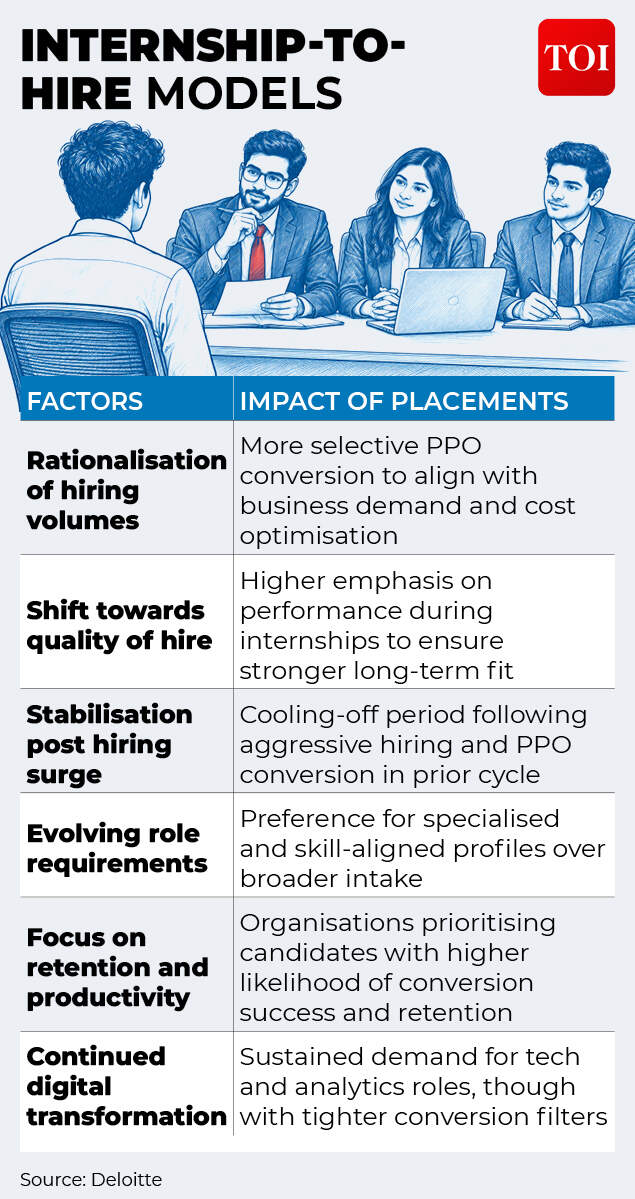
Internship-to-hire models
The signal is clear: Internships are becoming increasingly important.“For students nowadays it is clear, they cannot depend only on a degree and a campus interview anymore. Internships, projects, hackathons and demonstrable skills are becoming increasingly important signals of employability,” he adds.Deloitte’s report also finds that organisations are increasingly prioritising candidates who demonstrate stronger role fit, performance during internships and job readiness.The report notes a shift towards quality of hire and higher emphasis on internship performance. In fact, data from the report shows that the attrition rates up to two years of joining a job also fall when the hiring has happened through the internship to PPO route.
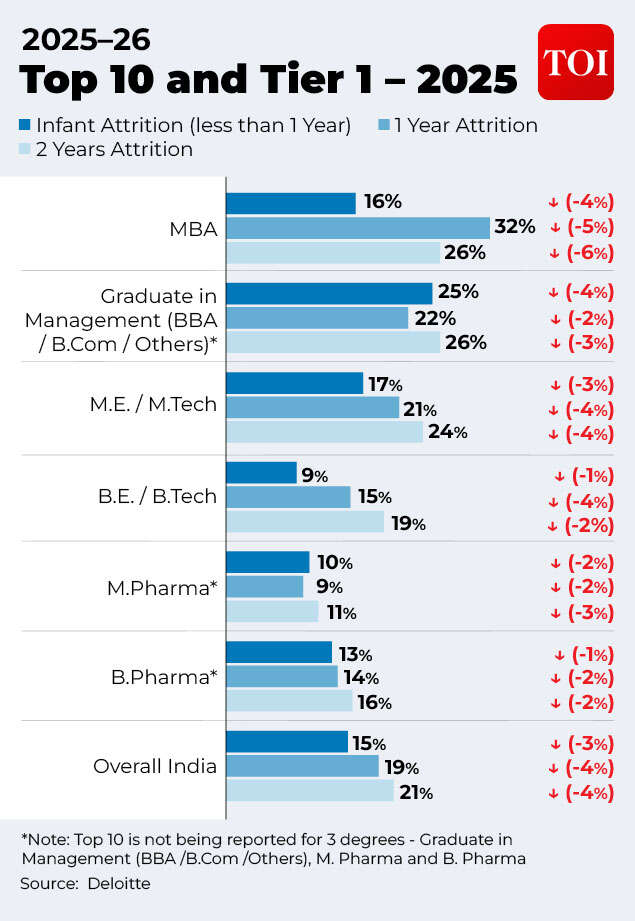
Attrition rates for PPOs fall
Neeti Sharma notes that employer intent to hire freshers actually rose to 75% in H2 2026, from 73% in H1.“The change is in what employers expect. A degree is increasingly the starting point, not the differentiator. Companies want evidence of practical skills through internships, apprenticeships, projects or certifications before making a permanent offer,” she says.
The bottom line
Experts say that rather than reducing opportunities, internship programmes appear to be evolving into an additional evaluation and conversion channel.Fresh graduates often enter a job without knowing enough exposure to understand whether they genuinely want to build their career in that particular tool or domain. An internship gives them an opportunity to experience the role before committing to it.Diwakar Chittora sees this largely a win-win model: Companies get to test talent before hiring, and candidates get to test a career before committing to it.From an IT sector perspective, however, he doesn’t see internships completely replacing traditional campus hiring, particularly for companies hiring thousands of graduates every year.
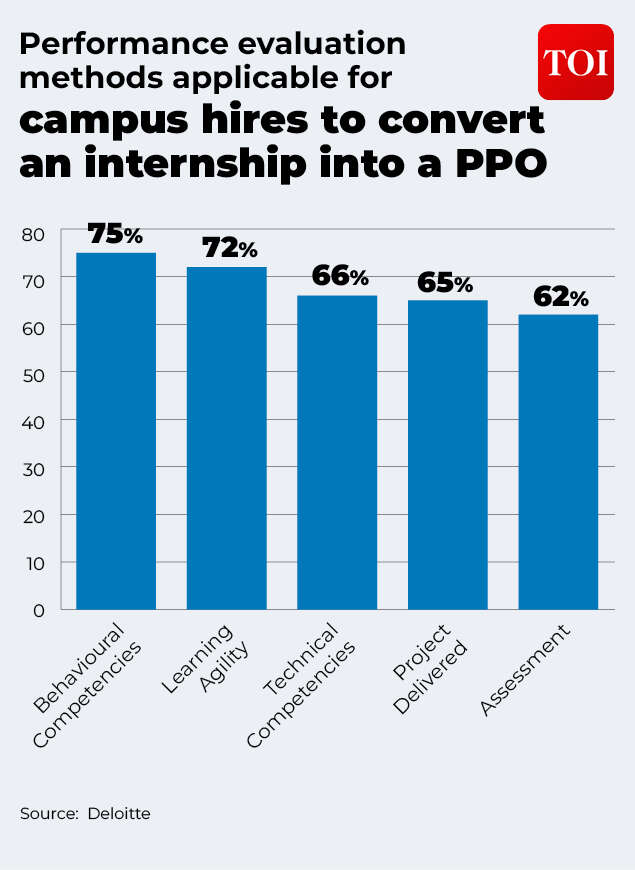
Performance evaluation methods applicable for conversion into PPO
“Instead, we are likely to see a hybrid model, where campus hiring continues but internships, pre-placement offers and project-based evaluation play a much bigger role in determining who finally gets hired,” he says.“The bottom line is that internship to PPO conversions are the pathway to a permanent role in an organization. In case a student is not able to secure a PPO post internship, they have to compete for permanent roles during the balance of the campus placement cycles when organizations come for placement. Since PPO conversions range between 15-20% of the class, the majority part of the placement happens outside the internship route,” says Neelesh Gupta.However, he cautions that the trend should not be interpreted as a replacement for campus hiring.“Instead, organisations are using internships to identify job-ready talent earlier, improve hiring quality and strengthen long-term retention, while continuing to invest significantly in direct campus recruitment.” he concludes.