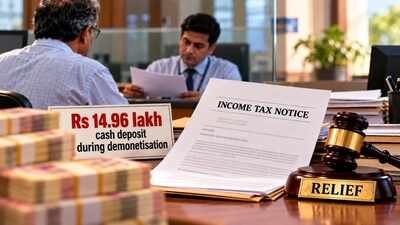


Cash deposits made in bank accounts can invite income tax scrutiny if the assessing officer is unable to detect a clear trail and source. In one such case a pharmaceutical and medicines retailer based in Delhi, found himself facing an income tax notice after depositing Rs 2.47 crore in cash into his own bank accounts.His explanation was rejected by the tax department and CIT(A), forcing him to subsequently appeal in the Income Tax Appellate Tribunal (ITAT), Delhi, where he managed to win relief.
What the case is about
The deposits in question were made by the medicine shop owner in three savings accounts.They were questioned by the Income Tax Department as unexplained cash.The shop owner said that deposited cash had come from sales generated by his pharmacy and had been properly recorded for in the concerned business books. To support his explanation, he submitted an audited balance sheet, VAT (value-added tax) returns and sample sales invoices.The Assessing Officer (AO), however, did not accept his account.The officer said that the expenses that were recorded in the profit and loss statement did not have corresponding debit entries in the bank accounts. The AO also alleged that salary and bonus payments had not been made regularly.The Commissioner of Appeals (CIT(A)) also upheld this assessment and rejected the medicine shop owner’s explanation. The man then challenged this decision before ITAT Delhi.Following a prolonged legal battle, the shop owner managed to secure a favourable decision from the Delhi ITAT on July 7, 2026.
Why ITAT Delhi ruled in favour of the medicine shop owner
ITAT Delhi noted that the medicine shop owner had placed several financial records before the authorities to establish the source of the cash deposits. These included his financial statements, balance sheet, profit and loss account, bank statements, VAT returns and sample sales bills.The documents were submitted to demonstrate that the cash generated through sales came from the pharmaceutical stock and was subsequently deposited into his bank accounts.The tribunal found that neither the Assessing Officer (AO) nor the Commissioner of Appeals (CIT(A)) had identified any defect in the documents and evidence furnished by the man. Further, neither authority had rejected his books of accounts under Section 145.On this basis, the ITAT Delhi concluded that the cash deposited could be directly linked to sales made during the demonetisation period, considering that he operated a retail business dealing in medicines and pharmaceuticals, according to an ET report.The tribunal also accepted the man’s explanation regarding the cash withdrawals from his bank account. It noted that the money had come from savings accumulated by his family members, and the medicine shop owner had even substantiated the withdrawals through his bank statements.According to the ITAT Delhi, the family had accumulated savings of Rs 72 lakh, while the man’s own savings were Rs 2.46 lakh. These amounts were supported by his statement and documents submitted by the family members.For instance, the man’s brother’s wife had savings of Rs 15 lakh, as reflected in the copy of her income tax return (ITR) submitted before the tribunal.The ITAT Delhi further observed that the CIT(A) had rejected the man’s explanation without providing any convincing reason for doing so.The ITAT Delhi ruled: “We noted that the explanation submitted by the assessee along with evidence regarding the availability of cash is enough to prove the assessee’s claim, and we find no infirmity in the same.”Chartered Accountant Ashish Niraj, Partner at A S N & Company, told ET that during scrutiny of cash transactions relating to the demonetisation period, income tax officials examined each deposit with suspicion, placing the responsibility on taxpayers to establish that the transactions were genuine.Niraj explained that the tribunal was satisfied with the material placed before it and accepted that the assessee had been able to establish the source of the deposits through cash withdrawals, his personal savings and savings belonging to family members.Niraj says: “This judgement gives learning that even if you have done cash transactions in crores, if supporting documents are properly kept, negative assessment can be challenged and won.”