A collection of 114 silver coins buried during the late Roman period and discovered during road construction in Kent more than six decades ago has sold for £23,240 at auction. The money will help preserve the archives of the local historical society whose members played a major role in recovering the ancient treasure.The coins formed the first part of the Springhead Hoard, discovered on October 22, 1964, when workers were widening the A2 road near Springhead in Kent, England. Members of the Gravesend Historical Society joined the recovery effort after the hoard was uncovered.According to the official website of auction house Noonans, the 114 silver coins, known as ‘siliquae,’ were sold on November 10, 2026. All the coins found buyers, and the sale exceeded the auction’s highest estimate of £15,000. The remaining coins owned by the society are scheduled to be offered in spring 2027.The proceeds will support the society, which was founded in 1924 and recently marked its centenary. The money will be used to store, conserve and digitise its research archive, including photographs, documents, excavation records and artefacts from the Roman site.
Coins remained buried for around 1,600 years
The Springhead Hoard is believed to have been buried around AD 388, during a period of political unrest, raids and rebellion in the late Roman Empire. The coins were struck under several Roman emperors, spanning the reigns of Constantius II to Magnus Maximus.They remained underground for approximately 1,600 years before road-widening work brought them to light. The discovery took place at Springhead, the site of the Roman settlement known as Vagniacis. According to Richard Taylor, honorary secretary of the Gravesend Historical Society, the organisation had been excavating the area since the 1950s. Its members had uncovered remains of temples, shops and roads at the settlement, which stood along the Roman route known as Watling Street.In a pre-auction account published by Noonans, Taylor said travellers using the road may have stopped at the religious centre to pray for healing and good fortune. The excavation became particularly important after the hoard was found. A total of 447 coins were recovered, with the historical society’s members contributing significantly to the search.
Volunteers searched on their knees as roadworks continued
Victor Smith, one of the original excavators, was among the society members who helped recover the coins. He attended the November 10 auction, more than six decades after the discovery. Recalling the recovery work in an earlier statement published by Noonans, Smith described how members searched on their knees, moving along parallel lines separated by strings while heavy earth-moving machinery continued working nearby.In January 1965, an inquest at Northfleet Town Hall declared the hoard Treasure Trove. The British Museum took 27 coins, including the gold pieces. The Gravesend Historical Society acquired the remaining 420 silver siliquae using its reward, supplemented by money from its museum fund.
Some coins sold for several times their estimates

Photo: Canva
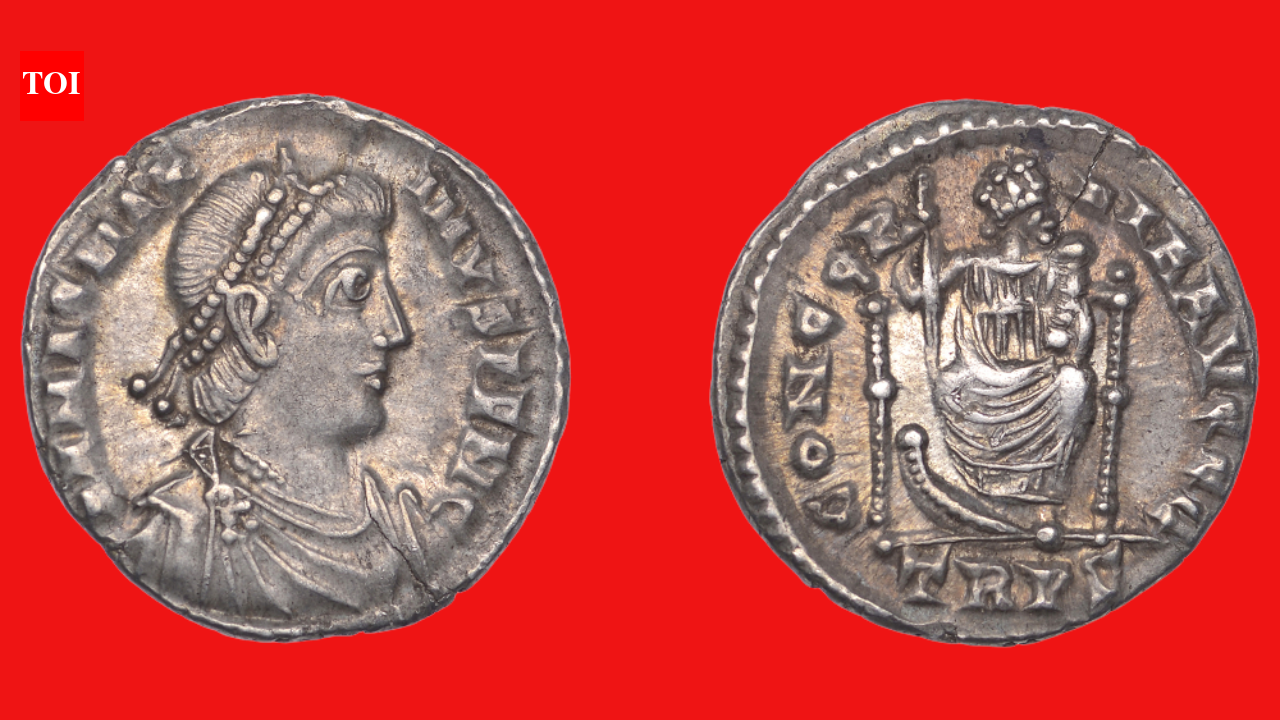
The first auction included coins from several Roman emperors, with some attracting bids well above their estimates. According to Noonans, a silver siliqua from the reign of Gratian (367–383), minted in Trier between 367 and 378, sold for a hammer price of £440 against an estimate of £100–£150. One side showed a draped bust, while the other depicted Roma seated on a throne.A coin from the reign of Magnus Maximus (383–388), also minted in Trier, fetched £420 against an estimate of £100–£150. Another from the reign of Theodosius I (379–395) sold for £400. A coin from the reign of Valentinian II (375–392), minted at Aquileia in north-eastern Italy, achieved £380.Noonans’ auction report records a gross sale total of £23,240, rising to £28,818 when the buyers’ premium is included.
Sale proceeds to preserve Gravesend’s local history
The society plans to retain a small representative group of coins, including examples from each emperor represented in the hoard. These will remain in Gravesend as a permanent reminder of the discovery.The money raised from the sale will help the organisation preserve and make its historical archive more accessible to residents, schools and researchers. The remaining coins from the society’s collection are expected to be auctioned in spring 2027, continuing a sale that began with the first 114 pieces.