

India’s holdings of the US Treasuries have dropped as per the latest data from US Federal Reserve.
Gold has surpassed US Treasuries to become the world’s largest reserve asset – driven largely by the rise in bullion prices in recent years. But the other reality is that gold as a reserve currency, diversifier and safe haven asset is increasingly gaining prominence in a multipolar world fractured by geopolitics and evolving trade dynamics.India is among major economies that are stepping up purchases of gold, while trimming holdings of US Treasuries. Central banks have increasingly begun viewing gold not only as a hedge against inflation but also as a core store of value. As a result, many have expanded their bullion holdings while reducing their exposure to US Treasuries.A recent World Gold Council report points out that central banks have bought an average of 1,000 tonnes of gold over the past four years. This is double the 500 tonnes average over the preceding decade.
India’s changing forex reserves mix
India’s holdings of the US Treasuries have dropped as per the latest data from US Federal Reserve. There has been a 22.5% fall from $232 billion in April 2025 to $181 billion in April 2026. In fact, at the current levels the holdings are down to a six-year low.Some of the fall that is visible has been partially offset by RBI’s aggressive buying of gold – a trend that has picked up in the last few years. Six years ago, India’s gold reserves stood at 658 metric tonnes which has risen to around 881 metric tonnes as of now – a 33.9% rise!The shift from US Treasuries to gold is a sign of a strategy that is globally becoming a trend in major economies – reducing dependency on dollar denominated assets.At the same time, India is also stepping up efforts to internationalise the rupee. This is being done through trade settlements and currency agreements with several countries.In fact, China is leading this trend. In the last one year, from April 2025 to April 2026, China’s holdings of US Treasuries have come down sharply from $743.6 billion to $651.1 billion – a decline of 12.44%. It is the biggest seller of US Treasuries since January 2025. According to a Bloomberg report earlier this year, China has asked its banks to cut exposure to US Treasuries. The move has been framed as a bid to diversify market risk. While China continues to be the third largest non-US holder of Treasuries, the holdings have dropped 14% since the start of 2025.
India Not Just Buying But Also Moving Gold Back
Yet another trend that stands out is India’s decision to shift back a substantial portion of its gold holdings from abroad. From October 2025 to March 2026, over 100 metric tonnes of gold has been brought back, as per RBI data. From 2023 to 2025, 280 tonnes had already been brought back.Why? Because foreign exchange reserves are an external buffer that is important for any economy. With growing geopolitical risks, uncertainties on assets being suddenly frozen due to evolving geopolitical policies, and tariff related trade uncertainties, India is choosing to keep its gold reserves domestically.
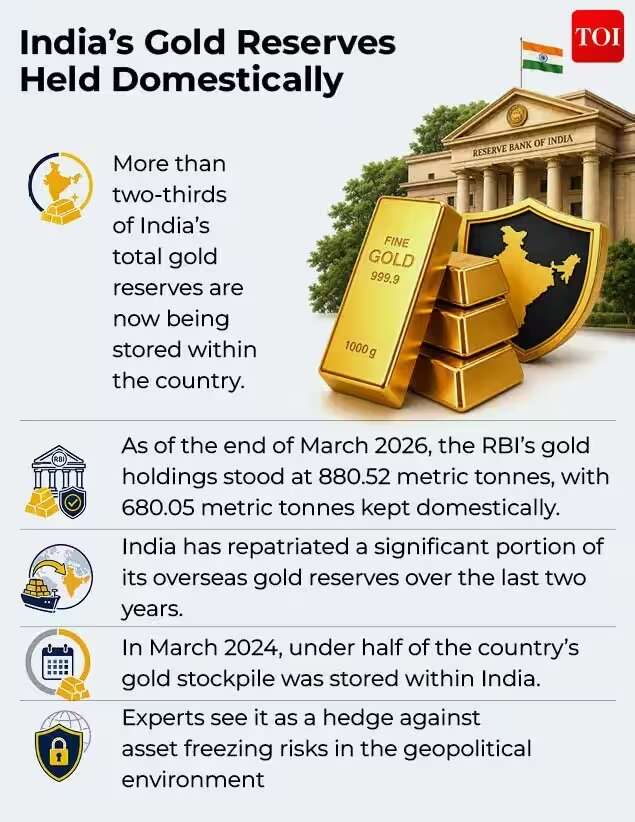
India’s Gold Reserves Held Domestically
At the end of March 2026, RBI had around 880.52 tonnes of gold. 680.05 tonnes of these were held in India. In a span of three years the percentage of India’s gold reserves held domestically has gone up from 38% to 77%!Experts see several advantages to India storing its gold at home – security and cost among the main. Experts see the move to bring back gold reserves as a step that ultimately reduces India’s vulnerability to any external ad-hocism.
Why is Gold Gaining Prominence in Forex Reserves?
Gold doesn’t belong to any particular country. It is a universal currency and asset, and that is where its fundamental safe haven value lies.One factor that contributes to the shift is that the utilisation of reserves held in US Treasuries has to be through formal channels and those channels could become unavailable during times of conflict. The Russia-Ukraine conflict has brought to light the vulnerability of assets held in other currencies – the freezing of assets has made an important point to hold reserves that are not subject to such risks. Madan Sabnavis, Chief Economist at Bank of Baroda explains: As gold does not belong to any country, it has an advantage over other currencies. Also, after the Ukraine war started, the US has impounded treasuries held by Russia. This has probably made countries think more about diversification because reserves have to be held in a safe asset which one can assume will never be held back by any authority. Gold has this advantage.One thing is clear: The need for more diversified foreign exchange reserves has been highlighted by the geopolitical events as well as the fiscal position of other major economies. This is a global trend in central banks. “Countries are trying to diversify their portfolio of reserves and they would like to have the ability to have the resources to finance emergency needs under scenarios when other holdings could become illiquid. Gold reserves are one such asset and hence there is a progressive trend of central banks increasing their gold holdings,” explains Ranen Banerjee, Partner and Leader, Economic Advisory, PwC India. How does holding gold help? “Physical gold reserves can be transported to pay for emergency supplies. Besides, there is a higher risk of budget deficits growing in the US to a level that may lead to weakening of their currency over a period of time,” Banerjee says.Additionally, what works in the favour of gold is that its price is determined by market forces. “Holding assets in treasuries of US or EU also means that valuation can be subject to domestic policies being pursued. Gold is agnostic of such influences though historically has moved in reverse proportion to the dollar,” Madan Sabnavis tells TOI.
What are the likely trends going ahead?
Gold will continue to act as a diversifier for central banks globally, with many expecting to increase their holdings over the coming year.
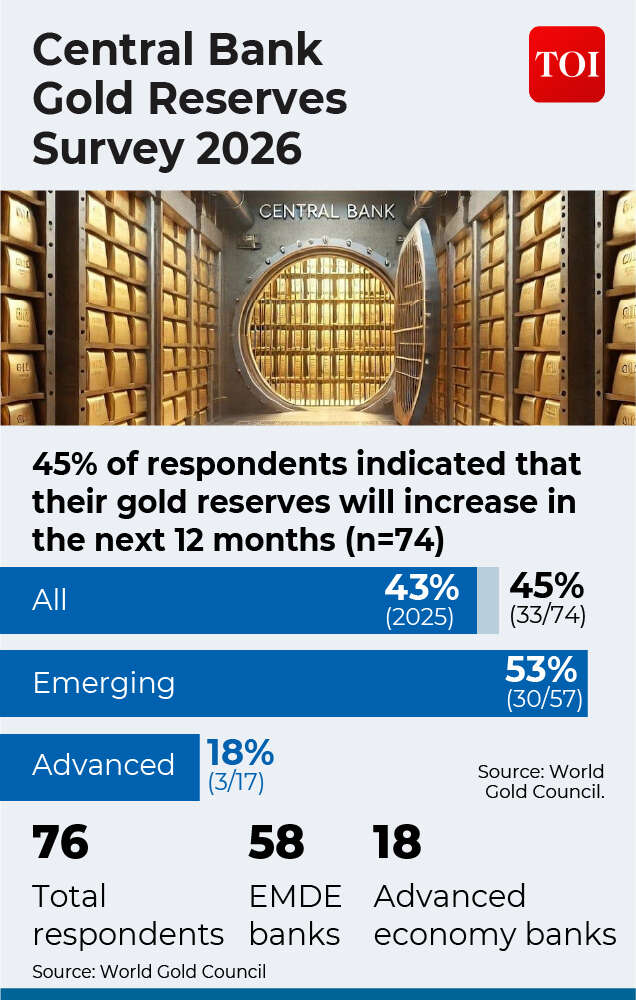
Gold reserves expected to increase in next 12 months
According to the latest World Gold Council (WGC) survey, central banks continue to hold favourable expectations on gold. 89% respondents to the WGC survey see an increase in their gold holdings over the next 12 months. Around 45% expect their own holdings to go up.“Gold’s performance during times of crisis, portfolio diversification and inflation hedging are some of the key factors for central banks to hold gold. In addition, gold as a geopolitical risk hedge and gold as part of a reserve diversification policy also feature as key reasons for increasing allocations to gold,” says WGC.
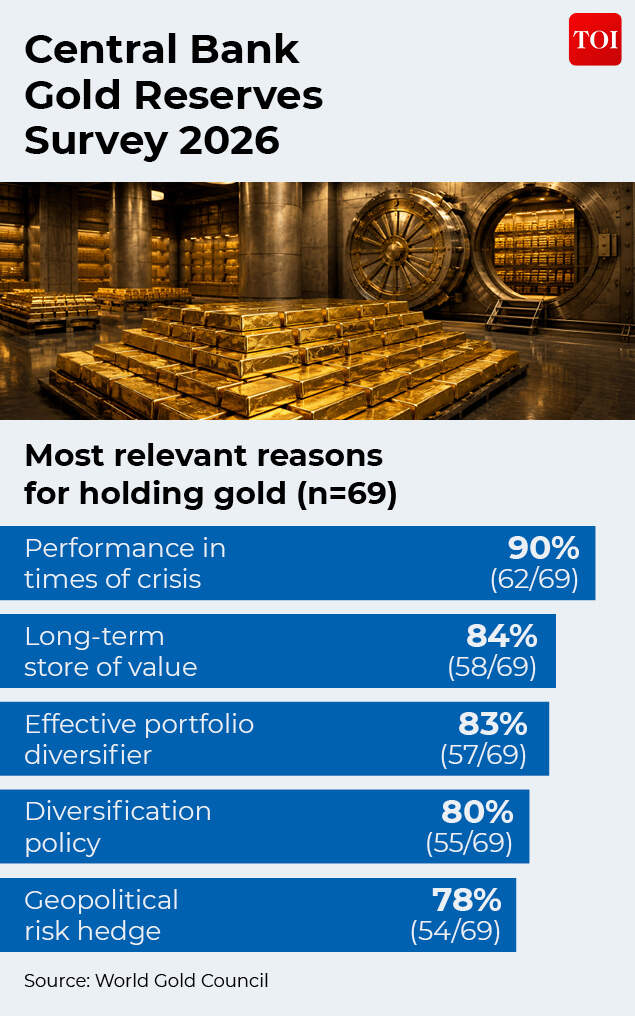
What are the top reasons for holding gold?
Not only that 74% of the respondents see moderate or significantly lower US dollar holdings within global reserves over the next five years. “Respondents also believe that the share of other currencies, such as the euro and renminbi will remain unchanged over the same period, while gold holdings will increase,” WGC said.
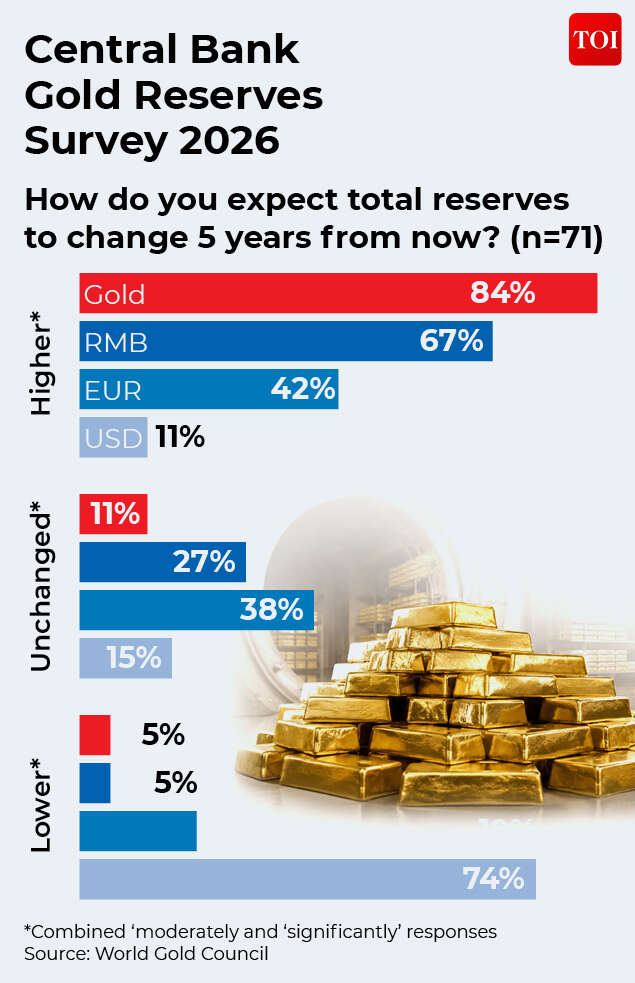
Positive change in gold reserves expected over next 5 years
Is the World Heading for De-dollarization ?
But as much as central banks opt for gold, for now, the dollar is not going anywhere, experts say. One big case in point is the recent rise in the dollar index in times of global economic uncertainty. Higher oil prices, safe haven demand, and a hawkish US Federal Reserve have all led to the US dollar strengthening in the past few months since the conflict began. Gold on the other hand has dropped from its record highs.An European Central Bank report shows that gold made up 27% of global central bank reserve assets at the end of 2025 – up from 20% a year earlier. Over the same period, the share of US Treasuries declined from 25% to 22%.
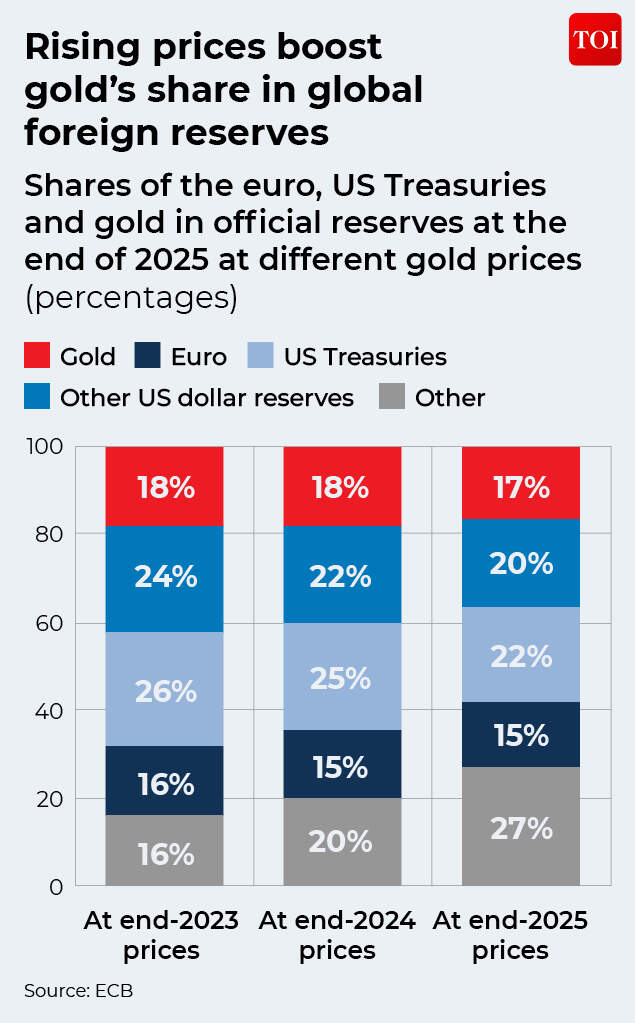
Rising prices boost gold’s share in global foreign reserves
Despite that shift, assets denominated in US dollars continued to account for the largest share of global reserves overall, which is 42% of the total.And not every major economy is cutting US Treasury holdings. For example, Japan and the United Kingdom’s holdings actually increased between March and April 2026.Hung Tran, a nonresident senior fellow at the Atlantic Council’s GeoEconomics Center says observers are of the view that the logic of TINA – there is no alternative – still applies. “The Atlantic Council’s Dollar Dominance Monitor points in the same direction. No other major currency, including the euro or the renminbi, is able to replace the dollar in its key functions in global trade and finance,” says Hung Tran.
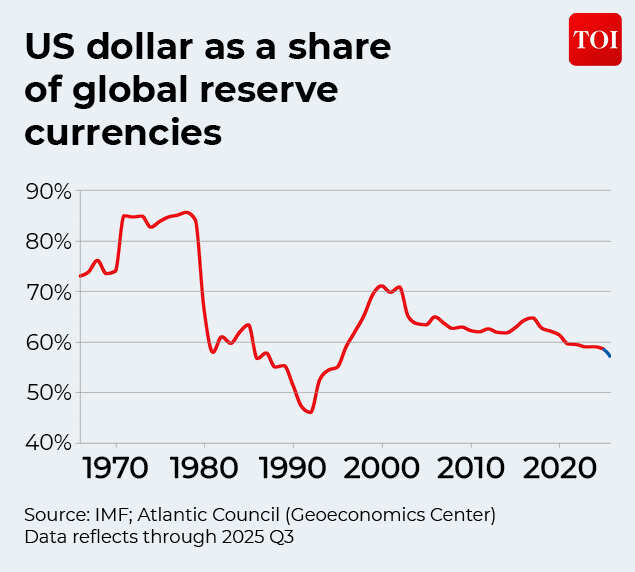
US dollar as a share of global reserve currencies
“That said, current market movements could signal early structural adjustments in the global economy, as it shifts from a fraying postwar, rules-based system—anchored by dollar dominance—toward a new and uncertain order. This transition is likely to be marked by considerable volatility and anxiety,” he adds.Experts see reduced dependency on dollar assets as a long-term and slow diversification process rather than an immediate reality for the global financial system.“De-dollarization as it is defined is a long-term process where nations and central banks gradually migrate their assets to a diversified portfolio. Today what we are seeing is an economic relation of an inverse movement of gold and dollar. The dollar index at over 100 means weaker gold which is what the market reveals. The motivation for moving away from the dollar is because of diversification which has a political angle besides the pure commercial rationale,” Sabnavis says.But if the trend persists, it would be a concern for the US where their debt will be owned more by domestic players and foreign institutions rather than central banks, Sabnavis opines.“For central banks this will be a slow process of accumulation as it also has the risk of valuation. If these quantities are large, then it can send a strong signal on de-dollarization- though this does not look likely as it is still a very small proportion of reserves held by central banks. Central banks could choose to diversify also into euro or yen which is what will be observed by markets,” he adds.The impact is likely to be seen in the coming years, not immediately, feel experts.“Over a medium term, gold as a reserve as it was in the past, and the currencies being supported by the value of gold reserves of the respective central banks will gain traction,” Banerjee says.The world is not witnessing a rapid collapse of dollar’s dominance. Instead, what is happening is a gradual diversification of foreign exchange reserves, trade settlement and payment systems. India and China are prominent economies that are increasingly taking this route.