


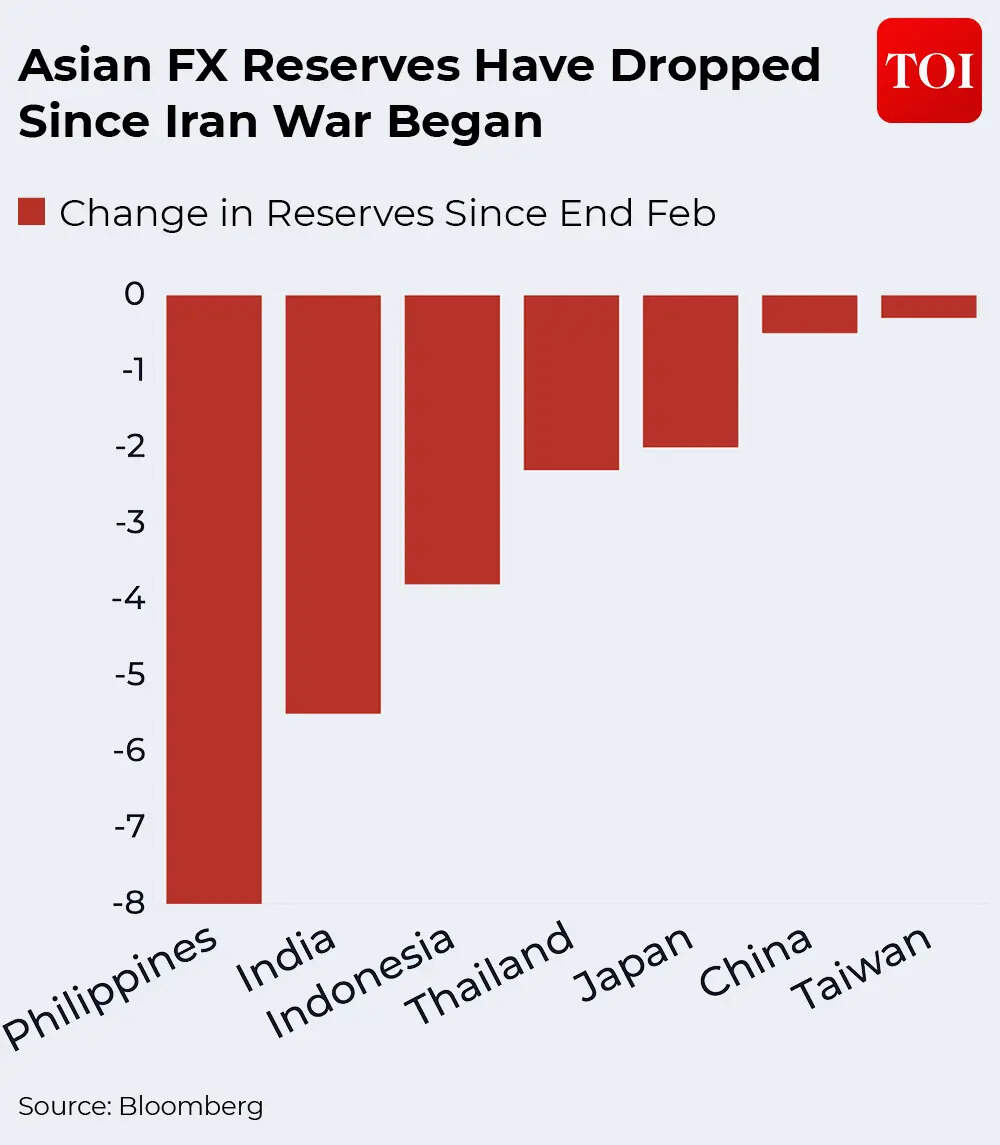
Philippines and India are the Asian countries that have seen the highest percentage losses to their foreign exchange reserves as a result of the ongoing US-Iran conflict that has sent global crude oil prices to above $100 per barrel levels. Foreign-exchange reserves across Asia are shrinking as central banks deploy funds to shield their currencies from the sharp rise in oil prices triggered by the Iran conflict.The erosion in reserves reflects not only intervention by policymakers to support domestic currencies, but also valuation losses in non-dollar assets, according to data compiled by Bloomberg.The decline has also weakened the region’s “import cover”, which is a measure of how many months of imports a country can finance using its foreign-exchange reserves. A lower import cover could eventually force policymakers to maintain tighter monetary conditions.Also Read | ‘Situation isn’t as dire’: Is India’s forex reserves cover enough to defend rupee? Why economists are confident
Philippines, India forex reserves hit the hardest
Among the countries that have seen notable declines are the Philippines, India and Indonesia. The Philippines’ reserves have dropped 8.1% to $104 billion since the conflict began, while India’s reserves have fallen 5.2% to $691 billion. Indonesia, meanwhile, has seen its forex stockpile decline 3.8% to $146 billion.The trend highlights how heavily Asia has been affected by the Middle East conflict because of the region’s dependence on energy imports. Even so, many analysts believe Asian economies are in a much stronger position than during earlier crises such as the Asian financial crisis of the late 1990s or the 2013 taper tantrum.
According to Duvvuri Subbarao, Asian nations, including India, have accumulated substantial reserves as a frontline defense mechanism, while their macroeconomic fundamentals are stronger than before. “Asian economies, including India, have built up reserves as a first line of defense — their macro fundamentals are also stronger today — but they are also typically large oil importers,” Subbarao, ex-RBI governor said. “Also, exports which have been the main growth driver of Asian economies are going to be hit.”Central banks across Asia have been intervening more actively in currency markets in recent weeks as rising energy prices continue to strain their economies. In Indonesia, authorities have pledged “smart interventions” in the foreign-exchange market and said they are prepared to use the full range of monetary policy tools after the rupiah repeatedly touched record lows, according to a senior official earlier this week.India, meanwhile, increased import duties on gold and silver on Tuesday in a move aimed at reducing bullion imports and supporting the rupee as the country deals with the economic impact of the Middle East conflict. People aware of the discussions said the government is also weighing additional emergency measures to strengthen foreign-exchange reserves, including a possible increase in fuel prices.Also Read | PM Modi wants Indians to cut gold buying: How much forex can be saved?In the Philippines, the central bank has been selling dollars in the foreign-exchange market to contain volatility as the peso approached the 60-per-dollar level. Despite those efforts, the currency weakened beyond that mark. Policymakers also raised benchmark interest rates last month and indicated that further tightening could be considered if required.Even with repeated intervention by regional central banks, currencies have continued to weaken significantly. Since the end of February, the Philippine peso has fallen 6.1%, the Indian rupee has declined 5%, and Indonesia’s rupiah has slipped 4%.According to BNY calculations quoted in the Bloomberg report, the Philippines’ import cover ratio has dropped from 9.9 months to 8.2 months, while South Korea’s has declined from 8.2 months to 6.9 months.Wee Khoon Chong, Asia-Pacific macro strategist at BNY in Hong Kong, said import cover across several Asian economies has deteriorated in recent months mainly because of higher import bills, especially for energy. He added that with crude oil prices still elevated, central banks are expected to continue intervening in currency markets in a restrained manner.The persistent weakness in Asian currencies is also forcing regional central banks to consider measures beyond routine foreign-exchange intervention. In India, the Reserve Bank of India has introduced additional steps to stabilise the rupee, including tighter limits on banks’ daily open forex positions to curb speculative activity in the currency market.Australia & New Zealand Banking Group Ltd. said the decline in reserves across Asia is making policymakers more cautious and could eventually lead to tighter monetary settings in some economies.Khoon Goh, head of Asia research at ANZ in Singapore, said that although authorities may use other tools to manage the situation, more central banks in the region may ultimately have to raise interest rates to contain inflationary pressures and reduce stress on their currencies.