

“Abki baar, sau paar” was the rallying cry when India arrived at the Hangzhou Asian Games in September 2023.By the time the Games ended, it had become more than a slogan. India had crossed the 100-medal barrier for the first time in its Asian Games history, eventually finishing with 106 medals — 28 gold, 38 silver and 41 bronze. The 100th medal came through the women’s kabaddi team, which defeated Chinese Taipei in the gold-medal match.It was India’s biggest-ever medal haul at the Asian Games.But as India prepares for Aichi-Nagoya 2026, the more important story is not that India finally reached 100. It is that 100 no longer looks like an isolated miracle when viewed against Indian sport’s larger trajectory.Hangzhou came after four consecutive editions in which India had already crossed 50 medals. India is becoming increasingly consistent.At the Asian Games, 50-plus medals have become the norm. At the Olympics, India has produced multiple medals at five consecutive editions for the first time.India remains an under-achiever. But the direction of travel is increasingly difficult to ignore.
From occasional highs to a new Asian Games floor
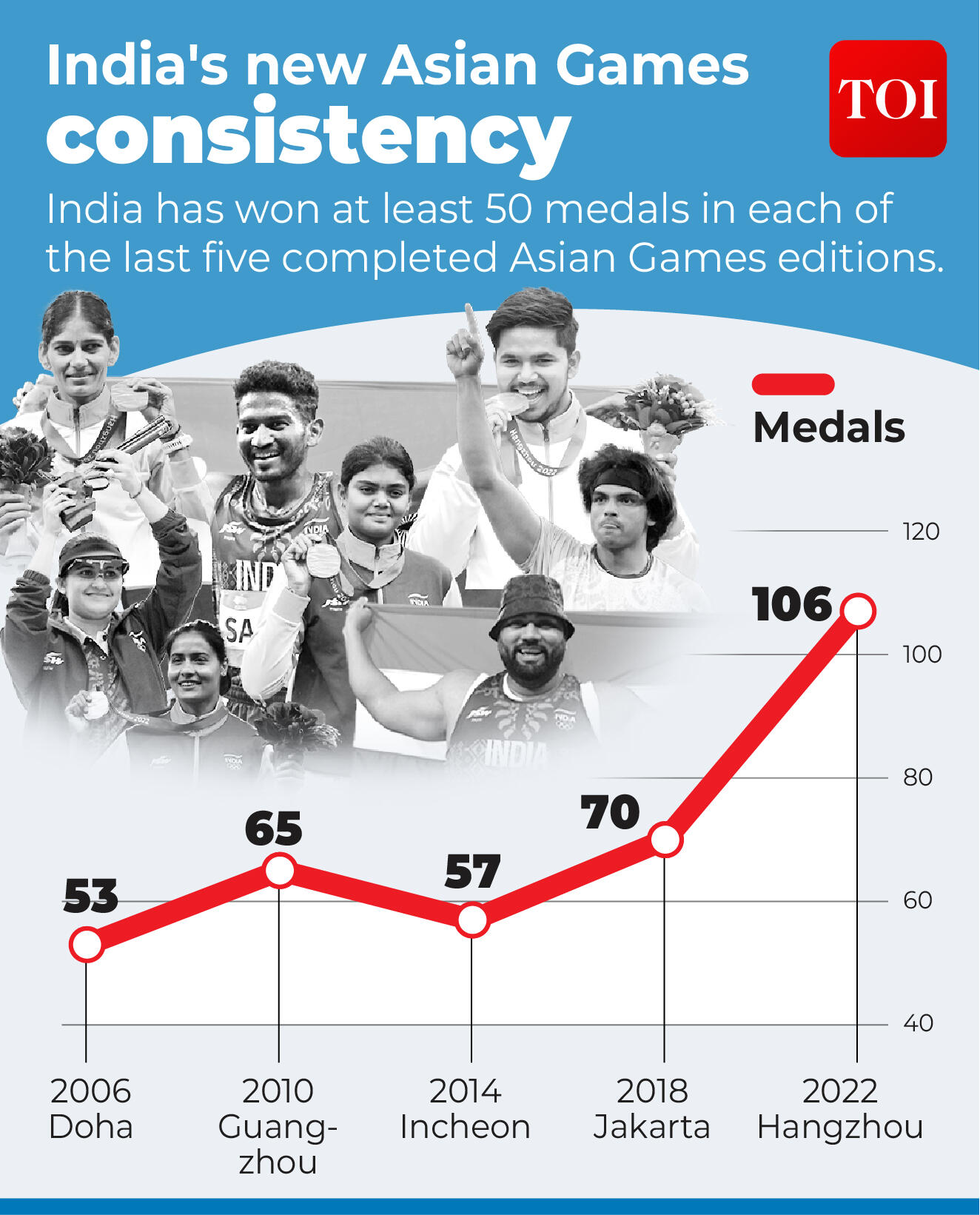
The strongest evidence of India’s sporting evolution is perhaps the simplest: 53 > 65 > 57 > 70 > 106.Those are India’s medal tallies at the last five completed Asian Games — Doha 2006, Guangzhou 2010, Incheon 2014, Jakarta 2018 and Hangzhou 2022.Before this run, India had crossed the 50-medal mark only twice in the previous 14 editions. Both came at home.At the inaugural Asian Games in New Delhi in 1951, India won 51 medals, including 15 gold. When New Delhi hosted the Games again in 1982, India collected 57 medals, including 13 gold.It took another 24 years for India to cross 50 again. Doha 2006 changed that.India won 53 medals in Qatar, finally breaking the half-century barrier away from home. It was followed by 65 in Guangzhou, 57 in Incheon and 70 in Jakarta and Palembang. Then came Hangzhou.The five consecutive 50-plus medal campaigns represent something India had never previously achieved at the continental event. That is arguably more significant than the 106 itself.A record medal tally can be an extraordinary peak. Five consecutive campaigns above a particular benchmark point towards a structural change.India has therefore entered Aichi-Nagoya with a different kind of expectation. Another 106 may be difficult, particularly with a 499-athlete contingent compared with the 661 who travelled to Hangzhou.But the benchmark has moved. The question is no longer simply whether India can cross 50. It is whether a 50-medal campaign would now be considered underwhelming.
Hangzhou did not just breach 100 — it moved India’s ceiling
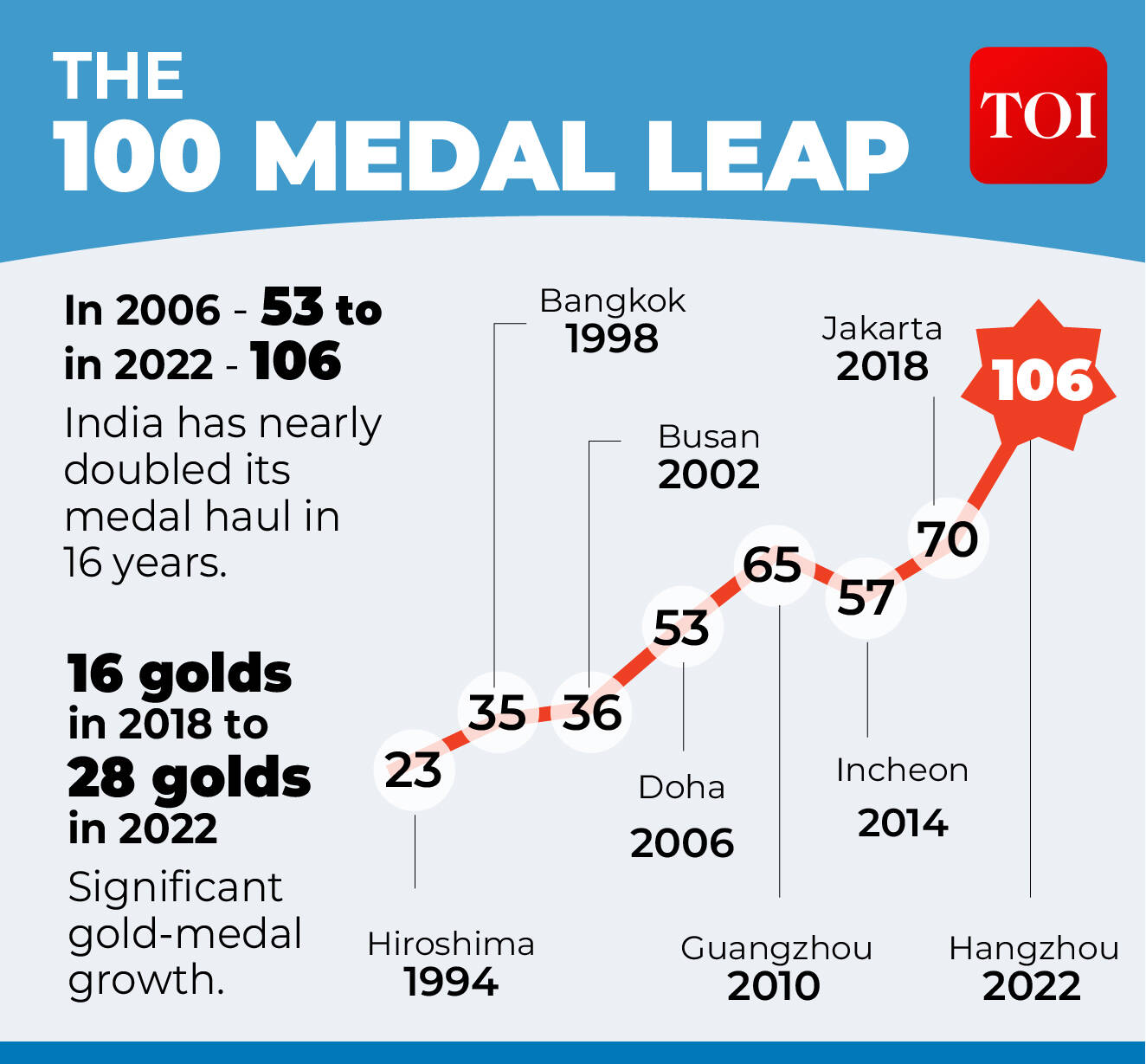
The jump from Jakarta to Hangzhou was extraordinary.India went from 70 medals in 2018 to 106 in Hangzhou, an increase of 36 medals. But the gold-medal jump arguably tells an even more significant story.India won 16 gold medals in Jakarta. In Hangzhou, it won 28. That is a 75 per cent increase in gold medals in one edition.And India’s Hangzhou medal haul (106) was twice its Doha tally (53) over a 17-year period.The 100-medal barrier, therefore, should not be viewed in isolation. India’s Asian Games ceiling has moved.It would be unrealistic to treat 106 as an automatic target every time India enters an Asian Games. But if India can produce another 70-plus campaign in Aichi-Nagoya, it would create another significant benchmark — three consecutive editions above 70.That could eventually make 70-plus the next version of what 50-plus has become today. One ceiling becomes the next floor.
The medal base is becoming broader
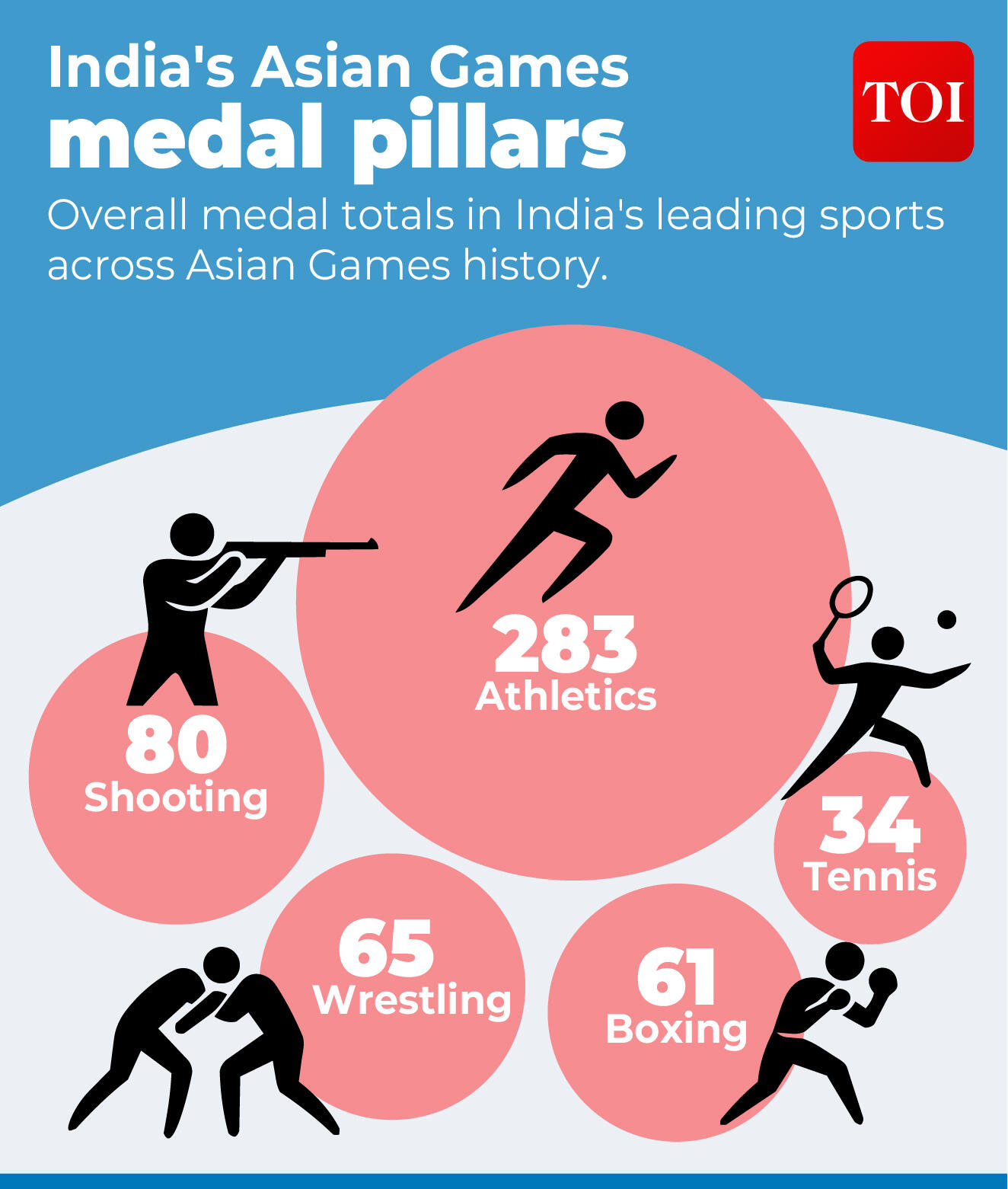
There is another part of the Asian Games story that is easy to miss when the conversation is dominated by the overall tally.India is not merely winning more medals. Its medal-producing ecosystem is gradually becoming broader.Historically, athletics has been India’s biggest Asian Games sport by a considerable distance, with 283 medals. Shooting follows with 80, wrestling with 65, boxing with 61 and lawn tennis with 34.Athletics remains the giant. But recent editions have shown that India’s medal ambitions are increasingly supported by multiple disciplines.Hangzhou was an excellent example. Athletics produced 29 medals, shooting contributed 22 and archery added nine. More importantly, shooting produced seven gold medals, one more than athletics’ six. That shows the modern Indian medal base is not entirely dependent on its biggest traditional discipline.Wrestling, boxing, squash, archery and tennis have repeatedly provided medal opportunities, while athletics and shooting continue to contribute.The Commonwealth Games in Glasgow in 2026 provided another encouraging indicator for boxing, with Indian boxers winning 10 medals, including seven gold — their best-ever gold-medal haul at the event.India’s sporting rise is becoming less dependent on one discipline or one generation. That is what a broader sporting ecosystem looks like.
The Olympics tell a quieter story of progress
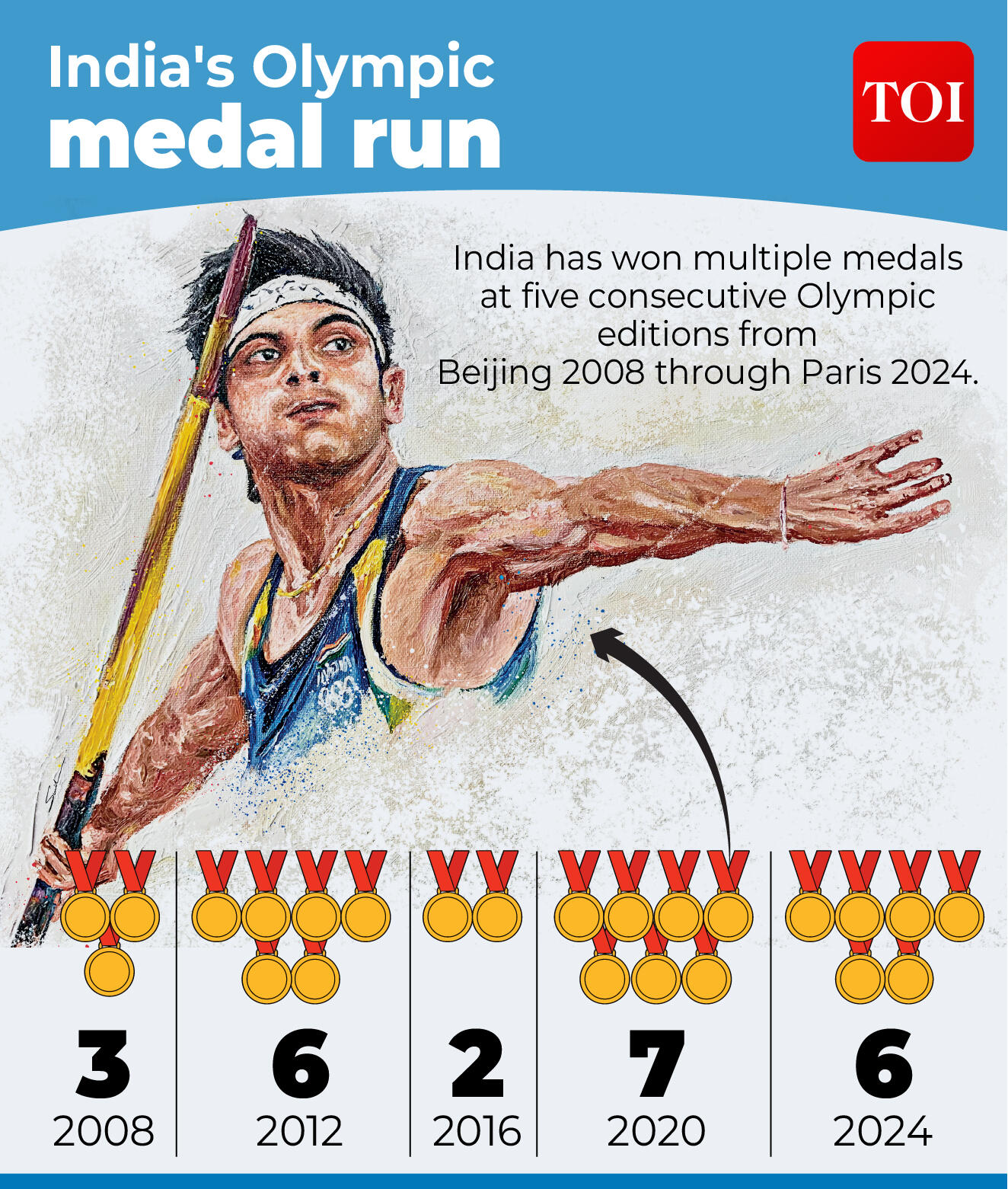
If the Asian Games provide the dramatic version of India’s sporting evolution, the Olympics provide the subtler one.India has won only 41 medals across its entire Olympic history — 10 gold, 10 silver and 21 bronze.For a country of India’s size and sporting ambitions, that remains underwhelming. But look at when those medals have arrived.From Beijing 2008 through Paris 2024, India won 24 of its 41 Olympic medals — 58.5 per cent of its entire Olympic medal haul in just five editions.Beijing 2008 produced three medals. London 2012 delivered six. Rio 2016 dropped to two. Tokyo 2020 produced a record seven. Paris 2024 ended with six.The numbers are not spectacular by the standards of sporting superpowers. But historically, they are significant.Before this five-edition run, India had achieved multiple-medal campaigns at only two Olympics — Paris 1900, when Norman Pritchard won two silver medals, and Helsinki 1952, when India won one gold and one bronze.Then came five consecutive Olympic editions with multiple Indian medals. That is the quieter revolution. And the country is no longer disappearing between Games. The consistency itself represents progress.
Paris showed how close India remains to a bigger breakthrough
The six-medal haul at Paris 2024 was disappointing because expectations had changed.After India’s record-breaking Asian Games campaign a year earlier, there was genuine hope that the country could finally push into double figures at the Olympics.It did not happen. But Paris also showed why the ambition for 10 medals was not completely misplaced.India had several agonising near-misses. The archery mixed team finished fourth after losing its bronze-medal match. Lakshya Sen lost the badminton bronze-medal match. Shooter Arjun Babuta finished fourth in the men’s 10m air rifle. Manu Bhaker, already a double medallist, missed out on a third medal after finishing fourth in the women’s 25m pistol. India’s skeet team lost its bronze-medal shoot-out, while weightlifter Mirabai Chanu finished fourth.Then came Vinesh Phogat’s disqualification before her gold-medal bout after she was found 100 grams over the weight limit.Seven “what if” moments.That does not mean India should retrospectively count those as medals. But it demonstrates how narrow the margins can be at the Olympics.Four of those near-misses becoming medals would have taken India to 10.The more important takeaway is that India is beginning to produce enough finalists and medal contenders across different sports for the conversation to shift from “Can India win?” to “How many can India convert?”That is a different challenge. And in many ways, it is a sign of progress.
The real evolution: India’s floor is rising
The Asian Games and Olympics operate on completely different scales, but together they reveal a striking change in India’s sporting story.The underlying pattern is comparable. India’s old sporting story was one of sporadic success. Its emerging story is one of sustained presence.At the Asian Games, India has established a 50-medal floor. Hangzhou then pushed the ceiling beyond 100.At the Olympics, India has established something much more modest but historically important: five consecutive Games with multiple medals.That is why the central story of India’s sporting evolution should not simply be “India is winning more medals.” It is that India is becoming increasingly consistent at winning medals.India is not there yet. The Olympic record remains underwhelming. But the direction is unmistakable. The floor is rising.
Aichi-Nagoya is the next test
India will enter Aichi-Nagoya 2026 carrying the weight of its greatest Asian Games campaign, but the objective should not simply be to reproduce Hangzhou’s 106.A 499-athlete contingent is heading to Japan, compared with 661 in Hangzhou. That difference makes a direct comparison difficult. The more meaningful test is whether India can sustain the performance level that has emerged over the last two decades.Can 50-plus remain the floor?Can 70-plus become the new expectation?Can more sports join the traditional medal pillars?Those are the questions that matter beyond the medal table.India may still be an under-achiever. But it is increasingly difficult to argue that the country is standing still.The medals are still not enough. The Olympic haul is still too modest. The Asian Games success still needs to be sustained. The conversion rate at the highest level still needs improvement. But the pattern has changed.From occasional Asian Games peaks to five consecutive 50-plus campaigns. From two historic multi-medal Olympics to five in a row. From a narrow collection of medal sports to a gradually expanding base.The peaks are getting higher. More importantly, the floor beneath them is rising.