
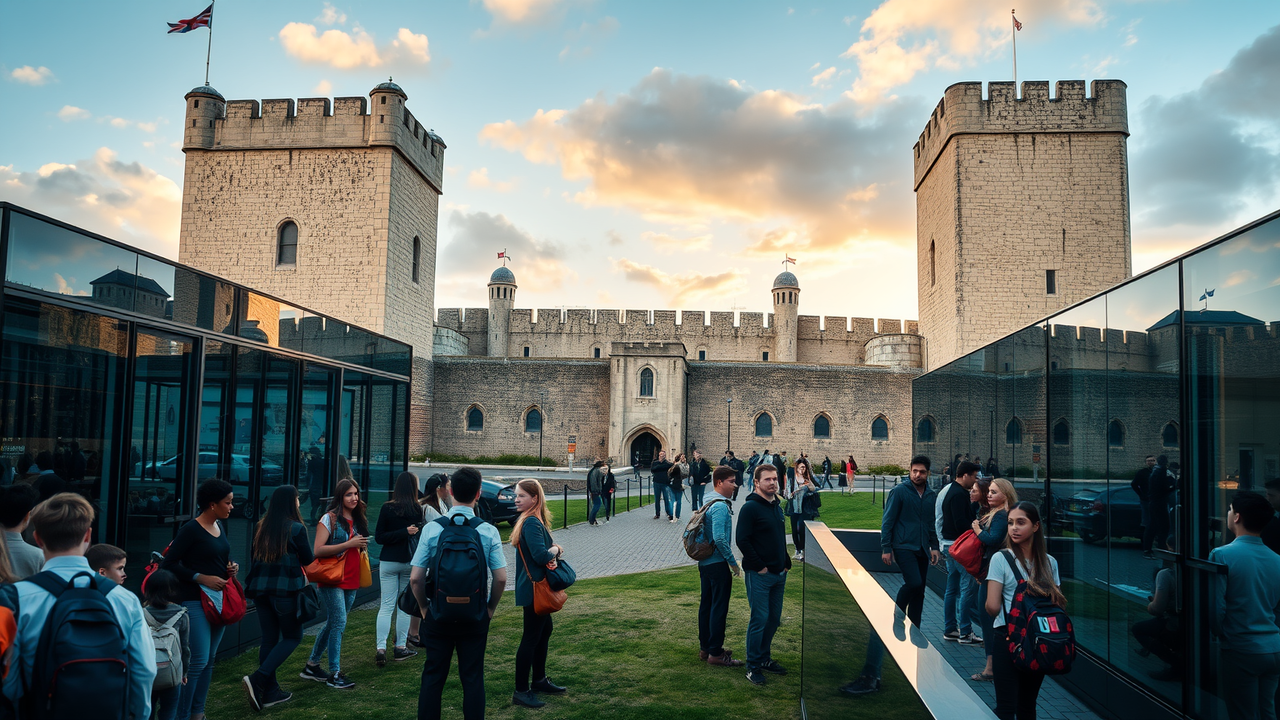
The Tower of London, a fortress standing on the banks of the River Thames for close to a thousand years, is preparing for one of the biggest changes in its recent history. Historic Royal Palaces, the charity that manages the site, has launched a new initiative called Tomorrow’s Tower, aimed at turning the historic landmark into a more open and accessible place for students, researchers and local communities. The project is already partly funded, and once complete, it promises to nearly double the number of young visitors the Tower can host each year while opening up parts of its history that have never been available to the public before.
What the Tomorrow’s Tower project actually involves
According to the official Tomorrow’s Tower announcement from Historic Royal Palaces, the plan centres on building two new education-focused facilities designed by Jamie Fobert Architects. These new spaces are intended to allow the Tower to welcome around 200,000 students annually, a significant increase from the roughly 125,000 it currently receives each year. In a statement announcing the project, John Barnes, chief executive of Historic Royal Palaces, said the Tower should be a place of learning, discovery and connection for everyone, describing the initiative as a long-term commitment to making that vision a reality.
Two new learning centres built for different age groups
School and community groups will begin their visit at the newly built Weston Learning and Community Centre, located along the Tower’s wharf, which will include hands-on learning spaces, a courtyard and a dedicated community room where visitors can take part in workshops led by costumed presenters. A short distance away, inside the historic Waterloo Block, the three-storey Julia Rausing Learning Centre will offer additional space designed to support youth projects, digital learning programmes, live broadcasts and professional development sessions for teachers, extending the Tower’s role well beyond that of a traditional heritage site.
Public access to more than two centuries of architectural records
One of the most significant parts of the renovation is the creation of a new Archive Study Centre inside the Julia Rausing Learning Centre. For the first time, visitors will be able to explore a collection of more than 25,000 drawings spanning over two hundred years of design, construction and conservation work, not only at the Tower itself but also at other historic royal sites including Kensington Palace, Hampton Court Palace, Kew Palace, the Banqueting House and Hillsborough Castle and Gardens. According to Vanessa Hodge, head of records for Historic Royal Palaces, opening access to these drawings will reveal the stories behind the buildings themselves, from major restoration campaigns and archaeological discoveries to the everyday conservation work that has kept these sites standing.
Turning the historic moat into a green classroom
Beyond the two new buildings, Historic Royal Palaces also plans to transform the Tower’s moat into what it describes as a green classroom, a space intended to offer hands-on learning opportunities connected to biodiversity, climate and the natural world alongside the site’s history. This addition reflects a broader shift in how the Tower hopes to engage visitors, moving beyond exhibits behind glass toward more interactive and outdoor-based learning experiences set within its centuries-old walls.
A history stretching back to William the Conqueror
The Tower’s story began shortly after the Norman Conquest of 1066, when William I commissioned the construction of the White Tower, which later grew into the sprawling fortress complex that stands today. Over the centuries, it has served as a royal palace, a military stronghold, a prison, a mint, an armoury and a treasury, and it became the site of some of English history’s most notable imprisonments and executions. Recognised as a UNESCO World Heritage Site since 1988, the Tower remains one of Britain’s most visited landmarks, drawing crowds for its Yeoman Warder guides and its collection of crown jewels.
Recent excavation work adds new layers to the story
The renovation announcement comes not long after archaeologists completed the first major excavation at the Tower of London in more than three decades. While installing a new elevator near the Chapel Royal of St Peter ad Vincula, built between 1519 and 1520 under Henry VIII, researchers uncovered what appears to be a mass grave dating to the fourteenth century, possibly linked to victims of the Black Death that swept through England from 1348 onward. The dig also turned up a range of artefacts, including charcoal pots, sewing needles, cannon balls, stained glass fragments, a ring and a pendant, along with the foundations of the original thirteenth-century structure that once stood on the same site, adding fresh detail to a history that continues to be uncovered even now.