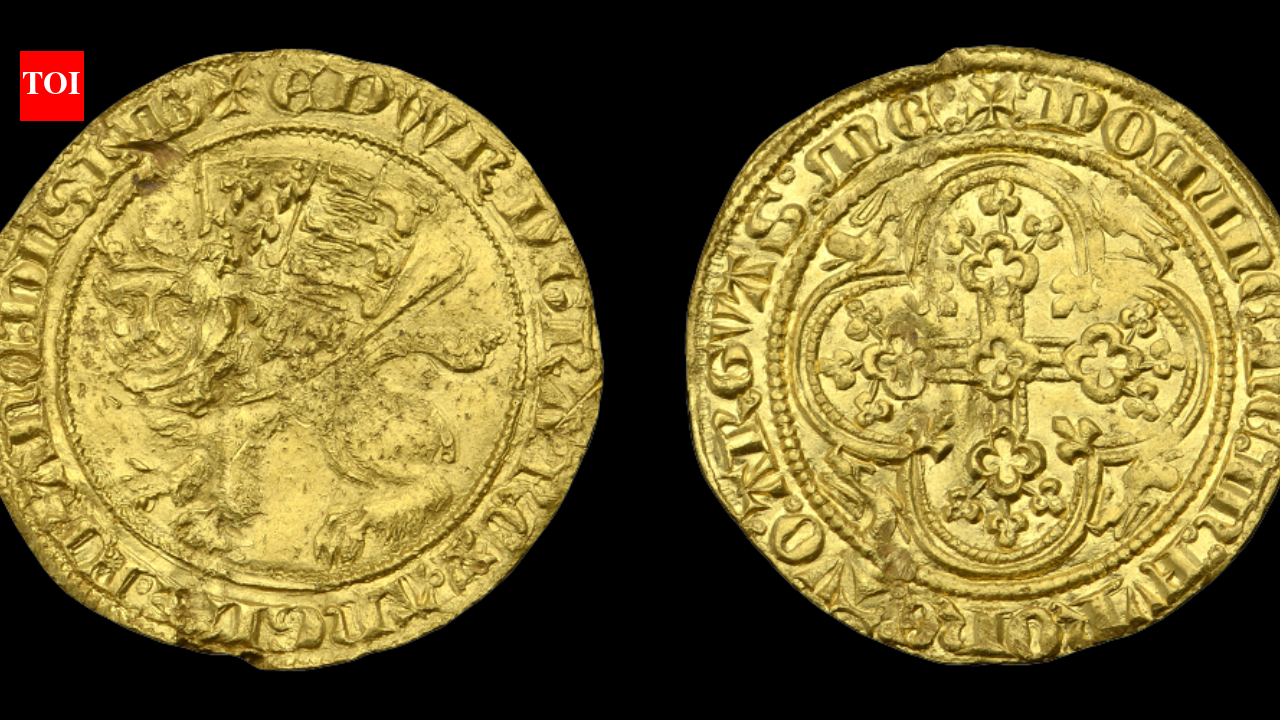
A rare 14th-century English gold coin that circulated for only seven months has sold for £70,000 at auction, after emerging from an ordinary suburban home. According to Antiques Trade Gazette, the coin, known as a leopard and issued during the reign of King Edward III, was sold by Essex Coin Auctions on September 30, 2026, attracting competing bids from online and telephone buyers. Two telephone bidders contested the lot in the final stages, pushing it to its reported hammer price of £70,000.The coin’s short time in circulation is central to its historical significance. Edward III, who ruled England from 1327 to 1377, introduced a series of gold coins in 1344 as England sought to strengthen its own currency and support trade. The experiment included the double leopard, leopard and half-leopard. However, the coins were abandoned within months and replaced by a different gold denomination, the noble.
Why Edward III introduced the gold leopard
The British Museum’s historical record explains that England’s move towards gold coinage was driven partly by the needs of international commerce. During the 1340s, gold coins from France and Florence were already widely used, and England wanted its own currency to play a stronger role in trade. Parliament petitioned Edward III to introduce gold coins, with the new denominations ordered in December 1343.The designs also carried political meaning. According to the British Museum, the gold florin featured the king seated with an orb and sceptre, flanked by two heraldic English leopards. A Gothic canopy and fleurs-de-lis appeared in the design, while the inscription included Edward’s claim to the French throne. These elements reflected the political ambitions that formed part of the backdrop to the Hundred Years’ War between England and France.The name “leopard” referred to the heraldic animals depicted on the coinage. The denominations included a double leopard, also known as a double florin, alongside the smaller leopard and half-leopard. The coins were made of gold and represented an effort to establish an English alternative to foreign currency used by merchants.
A currency experiment that lasted only months
Despite the ambition behind the launch, the leopard coinage proved unsuccessful. The British Museum notes that the new currency was overvalued, meaning its face value was higher than the value of the gold it contained. Its denominations also did not fit comfortably into England’s existing monetary system, making the coins less practical for everyday use.The Numismatic Guaranty Company (NGC), an organisation specialising in coin grading and authentication, says Edward III’s gold leopard coinage was struck between January and July 1344. The coins were then abandoned in favour of the gold noble, which became a more successful denomination. The leopard coins were officially demonetised on August 20, 1344.The noble was valued at six shillings and eight pence, equivalent to a third of a pound. The Royal Mint’s historical guide describes it as the first English gold coin to become firmly established in circulation. It was issued alongside half-nobles and quarter-nobles, and its design and usefulness helped it remain in circulation for far longer than the short-lived leopard series.The leopard’s brief lifespan helps explain its rarity today. NGC notes that relatively few gold leopard coins were struck and that many were probably melted down after the currency was withdrawn. Coins that survived the transition are now important examples of an early attempt to introduce a lasting English gold currency.
A rare survivor attracts collectors
The £70,000 sale reported by Antiques Trade Gazette illustrates the interest that such surviving pieces can attract in the collectables market. The publication reported that the coin was offered by Essex Coin Auctions on September 30, with a 22% buyer’s premium applying to the sale. It described the £70,000 result as the hammer price, so the figure should not automatically be treated as the buyer’s total bill after the premium.The report said bidding came from both online and telephone participants, with two telephone bidders competing towards the end. The coin’s emergence from a suburban home adds an unexpected element to the story, although the available report does not establish further details about the circumstances of its discovery. It would therefore be inaccurate to assume that it was found by a metal detectorist or to attribute a specific discovery date without additional evidence.Other surviving coins from Edward III’s gold coinage have also drawn attention. NGC records that two examples of the double leopard were found in the River Tyne by schoolchildren in 1857 and later entered the British Museum’s collection. A third known example was discovered by a metal detectorist in southern England in 2006 and sold at auction that year. These are separate coins from the one reported in the 2026 Essex auction.The British Museum’s records provide a further reminder of the coinage’s historical importance: Edward III’s gold florin was part of an attempt to support trade and strengthen the kingdom’s monetary system, even though the initial design and valuation failed to win lasting acceptance.